Sunday, August 19, 2012

STS-1 causeway pass and brochure

This week, some mementos of the first space shuttle launch.

On 12 April 1981—the twentieth anniversary of the first human spaceflight—space shuttle Columbia launched on STS-1, the first orbital test flight of the Space Transportation System. The flight was originally intended to have taken place in June 1979.

Thirty years later, it’s perhaps easy to forget just how revolutionary the space shuttle was, how utterly unlike any previous spacecraft. The delays in the program were due to the need to develop completely new technologies that a re-usable spacecraft demanded. Two key technologies that accounted for a large proportion of the delays were a heat shield that would not be sacrificed during re-entry, and engines that could be fired around fifty times when all previous similar engines were designed to be fired just once.

This brochure, issued by the Kennedy Space Center, describes the space shuttle, outlines the mission profile for STS-1, and introduces the crew:


This pass allowed a spectator’s vehicle onto the NASA Causeway to watch the launch. Ten kilometres (six miles) from the launch pad, this was the closest that the public could get to the pad.


Today, in 2012, there’s a certain amount of hand-wringing that NASA does not presently have human spaceflight capability, despite the work currently proceeding on various designs for the Commercial Crew Program and on the Orion multi-purpose crew vehicle. It’s worth remembering that by the time STS-1 launched, America had been without human spaceflight capability for nearly six years—the last flight had been the Apollo–Soyuz Test Project of July 1975.


Copyright information: the brochure and pass are works of NASA. As works of the United States federal government, they are in the public domain.

Sunday, August 12, 2012

Space Shuttle Columbia strap and construction photos

This week, photos of space shuttle Columbia as she neared completion, and a relic—a strap that flew on the shuttle.

Columbia, OV-102, was the second space shuttle built, and the first to fly in space. She was named after the sloop on which Robert Gray undertook the first American circumnavigation of the world in 1790 and explored the Columbia River in 1792. Construction began on 27 March 1975 at the Rockwell International plant in Palmdale, California (today, part of Boeing) and almost four years later, on 24 March 1979, Columbia arrived at the Kennedy Space Center for final integration and testing prior to launch.

This series of photos shows workers at Kennedy in 1979 attaching some of the 34,000 tiles that formed Columbia’s thermal protection system (TPS)—or heatshield:

108-KSC-79P-119
108-KSC-79P-319
108-KSC-79P-118


Note the numbers printed on the tiles, which indicated their placement on the spacecraft.

On 16 July that year, the first of Columbia’s three engines (engine number 2006) was fitted to the orbiter:


108-KSC-79PC-294


The third and final engine (engine number 2007) was fitted on 4 August:

79-HC-425

Even as NASA was issuing these photos to the press, the agency remained optimistic that the shuttle would fly soon. The back of one of these prints states:

“Columbia, the first in a new breed of manned, reusable spacecraft, is being readied for the first launch of the Space Shuttle later this year.”
In fact, Columbia would not fly till April 1981.

Columbia is represented in my collection by a strap from the orbiter. Note that this strap was removed during routine servicing and is not debris from the destruction of the spacecraft in the accident of 2 February 2003 that claimed her and her crew.


The strap is made of fabric (beta cloth, I presume) with press studs fitted to either end. It is 168 mm long and 22 mm wide (6⅔″ × ⅞″). It’s stamped with the word “SCRAP” in red ink, although this is barely visible in this photo. The strap and its NASA scrap tag were supplied to me by David Bryant of The Space Station in the UK. Note Columbia’s number—OV-102—written on the tag.

While all the other relics in my collection are samples of various materials, this is a complete unit, and is therefore one of my very favourite pieces.


Copyright information: all five photos are works of NASA. As works of the US federal government, all are in the public domain. I’ve noted their NASA serial numbers under each photo. I do not believe that the scrap tag contains enough expressive content to be eligible for copyright protection, but if it did, it is also a work of the US federal government and would be in the public domain anyway.


Sunday, August 5, 2012

Approach and Landing Test project medallion from NASA MFA Office

This week’s artifact is a medallion and certificate that NASA’s Manned Flight Awareness Office issued to employees and contractors upon the successful conclusion of the space shuttle Approach and Landing Test (ALT) program in 1977.

These tests validated the aerodynamic characteristics of the space shuttle orbiter in a series of flights in conjunction with NASA’s Boeing 747 Shuttle Carrier Aircraft (SCA). The initial flights saw the prototype shuttle Enterprise carried on the SCA from takeoff to landing, but in the final five flights, Enterprise was released in mid-air to glide back to the runway at Edwards Air Force Base by herself.

The medallion itself is is 38 mm (1½″) across and made of very light metal; mostly aluminium I think. According to the text on the reverse, it contains metal taken from Enterpriseone source on the Internet states that the material was taken from the left wing.
 
The obverse bears a relief depiction of the ALT patch design. The reverse carries the message:
“Thank you for your contribution toward making the Approach and Landing Tests of the Space Shuttle Orbiter successful. We would like you to have this memento made, in part, of metal taken from the Enterprise.”

It also features facsimiles of the signatures of the four test pilots who flew Enterprise during the tests.

I obtained this medallion in its original plastic packaging and have removed it only to photograph. The relatively rough manufacture of the item is evident here.

The accompanying certificate measures 305 mm × 240 mm (12″ × 9½″) and is printed on card. It’s larger and printed on heavier stock than the Skylab and Apollo–Soyuz certificates in my collection.

It too carries a depiction of the program patch, along with a silhouette of the Enterprise separating from the SCA. As depicted, Enterprise is flying without her tailcone, the configuration used in the final two flights of the program. There’s space for the name of the recipient (which I've blurred out here for their privacy), a message of thanks, and facsimiles of the crew signatures.


The message reads:

“The crews of the Approach and Landing Test Program are pleased to present you with this medallion in appreciation of your contribution to the successful ALT flights of the space shuttle orbiter Enterprise”

At the bottom is a circle the size of the medallion, together with a printed version of the reverse of the medallion, in case the recipient wanted to affix theirs to the certificate itself.


The ALT program was important in ensuring that the space shuttle flew as well in practice as it did on paper, and turned theory into practice. With the program a resounding success, Enterprise moved to the Marshall Space Flight Center in Huntsvile for vibration tests as work continued on preparing the space shuttle for service.


Copyright information: the medallion and certificate are works of NASA. As works of the United States federal government, they are in the public domain.

Thursday, July 26, 2012

Sally Ride lithograph from NASA and People Weekly magazine

An inevitable part of ageing is watching time claim your heroes one by one as the years go by. This week, the world lost Dr Sally Ride all too early. She was only 61.

On 18 June 1983, Ride became the first American woman in space when she flew as a mission specialist on space shuttle Challenger’s second flight, STS-7. This mission also made her—at the age of 32—the youngest American to fly into space, a record that stands to this day.

The copy of this portrait in my collection is a standard NASA lithograph, 8″ × 10″, serial HqL-135 and dated 1983. However, the picture was taken at the time of Ride’s selection into the astronaut program in 1978. She was one of six women out of the thirty-five people in this group. They were the first new astronauts recruited into the space program since the Apollo era and called themselves “TFNG”, publicly “thirty-five new guys”, but also familiar military slang for “the fucking new guy” in an astronaut corps that was still dominated by military test pilots.


Perhaps nothing speaks more painfully eloquently of the cultural importance of American women becoming astronauts than some of the questions put to Dr Ride at a press conference shortly before STS-7.

Some of these questions were documented by Michael Ryan, who wrote a feature on Ride for People Weekly at the time (“A Ride in Space”, 20 June 1983, pp.82–88). Ride was also pictured on the cover:


As recorded by Ryan, these questions included:
  • “Will the flight affect your reproductive organs?”
  • “Do you weep when things go wrong on the job?”
  • “Will you become a mother?”
Ride refused to answer this kind of crap, retorting instead, “How come nobody ever asks Rick those questions?” (Rick Hauk, the former US Navy fighter pilot and test pilot who was assigned to fly Challenger on their mission). My favourite of her responses was:
It may be too bad that our society isn’t further along and this is such a big deal.
Note that even the editor responsible for the magazine cover called these questions “dumb” and “chauvinist”. Awareness was certainly growing.

Elsewhere in the People Weekly article, Ride’s mother, Joyce, recalled that Johnny Carson had joked on-air that the the launch was being postponed until Sally Ride could find a purse to match her shoes.

This, of someone with a PhD in astrophysics and whose selection into the astronaut corps confirmed her place as one of the best, brightest, and most capable people of her generation.

Thirty years and a generational change later, it might be a little less likely that a woman would be treated this way today, but unfortunately, such attitudes are not confined to the history books just yet.

Following her death, it has emerged that Ride spent the last twenty-seven years of her life in a same-sex relationship. Her partner of all those years, Dr Tam O’Shaughnessy, will not be entitled to all the benefits to which she would be entitled if theirs had been a heterosexual relationship, as explained on this NASA table: Benefits Available to Same Sex Domestic Partners. I think this is profoundly sad and unjust. To me it seems that Ride’s words apply equally:
It may be too bad that our society isn’t further along and this is such a big deal.
when “this” is the sex of one’s partner.


Copyright information: the portrait lithograph is a NASA publication and as a work of the US federal government, is in the public domain. The People Weekly cover is copyright Time Inc. Use here is claimed to be fair use for the purpose of education and commentary in a non-commercial setting as permitted by 17 U.S.C. § 107.

Thursday, July 19, 2012

Space Shuttle Approach and Landing Test 5 press kit items from DFRC

This week I present the press kit from space shuttle Enterprise’s fifth and final free flight.

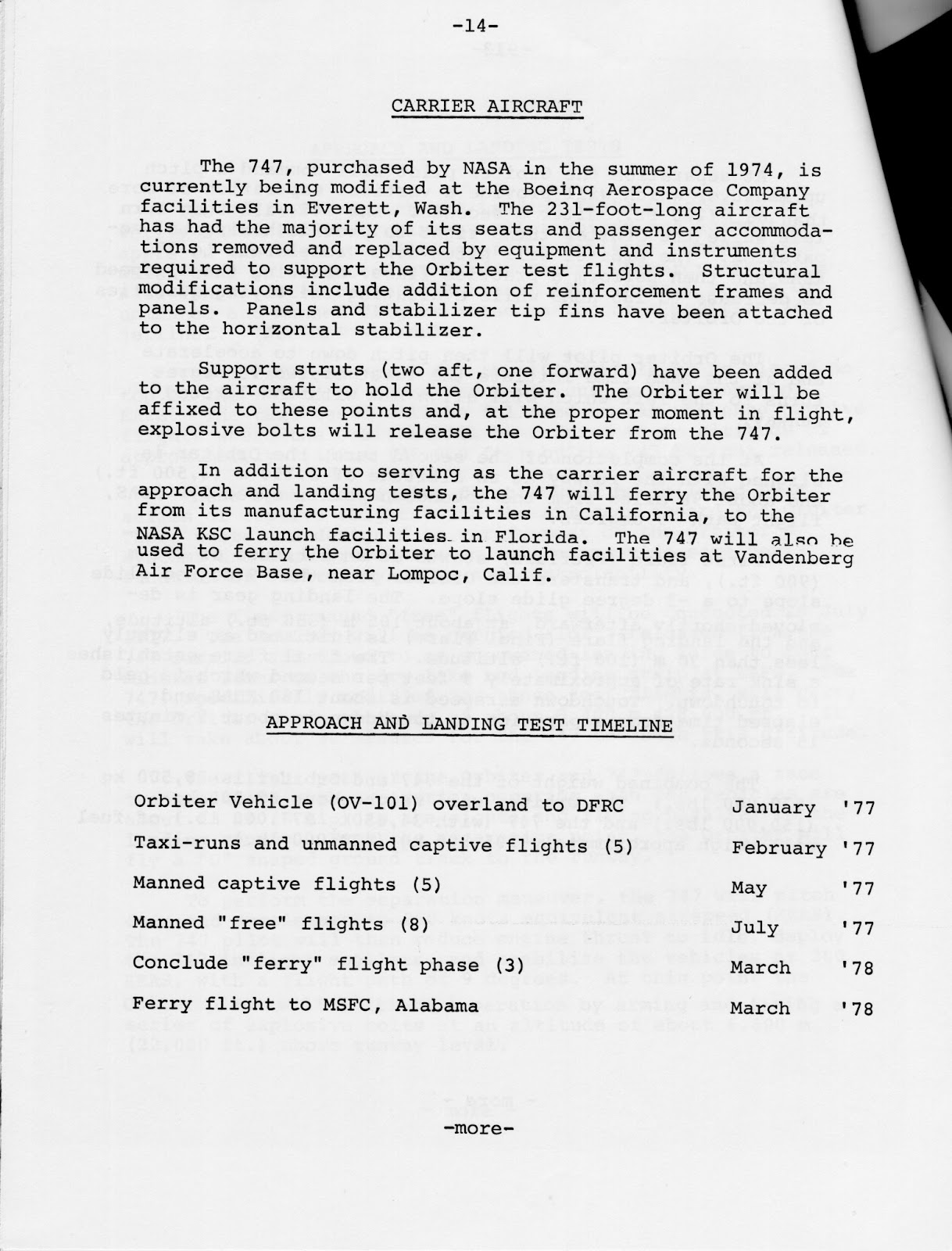
Before the space shuttle commenced operations, NASA validated the airworthiness of the orbiter design in a series of  test flights. The initial flights were “captive” tests, mounted on the Shuttle Carrier Aircraft (SCA), NASA’s modified Boeing 747. From 12 August 1977, the captive flights were followed by five free flights in which Enterprise was released from her mother ship to fly free to a landing at Edwards Air Force Base in the Californian desert. 

NASA planned that after these Approach and Landing Tests (ALT), Enterprise would spend a year undergoing vibration tests to verify other aspects of the shuttle design and would then be returned to Rockwell International (today part of Boeing) to be refurbished for orbital flight. This refurbishment never took place (a ground test airframe was refurbished instead to become Challenger) and the only times Enterprise took to the air again was as cargo atop the SCA on her way to various exhibition sites. These destinations included the 1983 Paris Air Show, the 1984 Louisiana World Exposition, the Smithsonian National Air and Space Museum, and the Intrepid Sea, Air & Space Museum, Enterprise’s current home.

Each of the Approach and Landing Tests was a little more ambitious than the one that went before. They began with Enterprise fitted with a streamlined tailcone covering the blunt rear end of the shuttle where the main engines were designed to fit, and with the shuttle descending to land on a dry lake bed with plenty of margin for error. By the fifth flight, of 26 October 1977, Enterprise was flying without the tailcone, with dummy main engines in place, and headed for touchdown on a conventional concrete runway.

It would be the worst landing of the whole shuttle program.

The NASA press release describes the test as planned for that day:


Coming in slightly fast, Enterprise missed the intended touchdown point, landed long, bounced back into the air, then started to roll before the crew brought her back down safely. 

This video shows the landing:


Lag in the responsiveness of the flight control system, together with the generally poor visibility from the Shuttle’s flight deck, had led the crew (commander Fred Haise and pilot Gordon Fullerton) into a series of overcorrections or “pilot-induced oscillation” (PIO). 

As a result, after this test, the flight control system software was modified to counteract the tendency for pilots to overcorrect in this way, at the expense of a little control sensitivity.


Copyright information: the press kit is a work of NASA. As a work of the US federal government, it is in the public domain. 


Thursday, July 12, 2012

Space Shuttle Approach and Landing Test 1 press kit items from DFRC

Sometimes real-world experience beats anything you can do in simulation. The space shuttle design relied on many bold design decisions, and the mode of the orbiter’s return to earth was one of the boldest of all.

All previous crewed spacecraft had been capsules that parachuted back to earth. However, after dropping out of orbit, the shuttle was to fly as a 100-tonne glider towards a landing on a conventional runway. The descent would be steep, and pilots would have only one chance to put the craft down safely. Although NASA considered fitting the shuttle with retractable jet engines, the agency’s experience with lifting bodies—wingless aircraft with a similarly steep rate of descent when flown as gliders—suggested that the weight of engines could be saved and that a steep glide was a perfectly feasible way to get the orbiter back on the ground. In 1977, NASA set out to prove this with the prototype shuttle, Enterprise in a series of approach and landing tests (ALT) at the Dryden Flight Research Center at Edwards Air Force Base in the Californian desert.1

The first of five flights took place on 12 August 1977. A few items from the press kit issued by NASA for the day set the scene.

This first item is a portrait of the crew assigned to the mission: Fred Haise (commander) and Gordon Fullerton (pilot). This is a standard 8″ × 10″ colour lithograph printed on card with a description on the back:


The second item is a pamphlet that describes the ALT program in general, together with an overview of the Space Shuttle system and the orbiter Enterprise in particular.


As described, the plan for the ALT program was as follows:
  1. Load the Enterprise on the back of a specially modified Boeing 747.2
  2. Carry it to an altitude of around 25,000 ft (7,600 metres).
  3. Release it from the 747.
  4. Pilot it back to earth. The shuttle would drop those 25,000 feet in a little over five minutes—around twice the rate of descent of a typical commercial jet flight.
This double-sided sheet provides details of the first free flight planned for 12 August 1977:


And finally, the schedule for the day for NASA guests staying at the Holiday Inn at Palmdale: on the bus at 5:30 AM to head out to Edwards Air Force Base; show over and heading back to Palmdale by 9:00 AM.


If you want to see the flight yourself, a video is available on YouTube. Enterprise separates from the carrier aircraft at around the 4′ 30″ mark, and touches down at around the 9′ 30″ mark.


Footnotes:
1 Prior to these tests, NASA conducted a series of flights with the shuttle mounted to its Boeing 747 carrier aircraft, initially without crew and without the shuttle’s systems powered up. Later flights had a crew aboard the shuttle and its systems active. NASA also made a series of flights with an F-104 Starfighter in close proximity to the 747 to explore the ability of the shuttle to separate cleanly from the carrier aircraft.
2 NASA had purchased its Boeing 747 from American Airlines in 1974 to use for aerodynamic research. In 1976, it returned this aircraft (registration N905NA) to Boeing for refurbishment as a carrier aircraft for the space shuttle.

Copyright information: all materials in this press kit were produced by NASA. As works of the US federal government, all are in the public domain. 

Thursday, July 5, 2012

Space Shuttle Enterprise rollout pass and press kit

On 12 March 1976, final assembly of NASA’s first space shuttle was completed at the Rockwell International plant in Palmdale, California (now part of Boeing). The shuttle bore the serial OV-101—for orbiter vehicle—and was originally to be named Constitution. Not only does this word have a special resonance for Americans, but the name has a long and proud heritage in the US Navy, and the shuttle was to be unveiled to the public on 17 September, Constitution Day.

However, Star Trek fans mobilised to ask the White House to name America’s first “real” (as in re-usable) spaceship after their beloved starship, Enterprise. John and Bjo Trimble, influential figures in the fan community, orchestrated a campaign which saw many thousands of letters sent. Estimates vary between 10,000 and 400,000, depending who you listen to.

On 7 September 1976, President Gerald Ford asked NASA Administrator James C. Fletcher to make the change, quipping “You know, I’m a little partial to the name Enterprise.”

This is a guest pass for the roll-out ceremony, which took place as scheduled ten days later, on 17 September:


It’s printed on thin card, on one side only, and measures 10 cm × 6.5 cm (4” × 2½”). The illustration is curious: it’s adapted from concept art of the shuttle being pushed out of the hangar in which it was constructed; this art appears on the NASA press kit for the event described below. However, as adapted here, it supposedly indicates the shuttle being towed out into the open, but shows the tractor driver still facing backwards. Note too the impossible shadows: the shadows under the tractor and shuttle confirm that the spacecraft is being towed out into the light of day, but the front half of the orbiter fuselage is in shadow, and the rear fuselage (still inside the darkened hangar) is illuminated.

The press kit for the event is thirty pages long and is printed on flimsy government-letter-sized paper. My copy is bound with a single staple in a position that makes opening it fully for scanning very difficult without damaging the document. I’ve included a few of the most interesting pages as a sample here.


I don’t normally post images on this blog that aren’t part of my collection itself, but as a dedicated Star Trek fan, I need to finish the story of the shuttle’s roll-out and this picture says it all really:

source: http://www.nasa.govStar Trek/multimedia/imagegallery/image_feature_1204.html
The name Enterprise is clearly visible on the shuttle’s side. Pictured in front of her are most of the Star Trek cast. Left to right are: NASA Administator James C. Fletcher, DeForest Kelley (Dr. McCoy), George Takei (Lt. Sulu), James Doohan (Scotty), Nichelle Nichols (Lt. Uhura), Leonard Nimoy (Mr. Spock), Gene Roddenberry (Star Trek’s creator), an unidentified NASA official, and Walter Koenig (Mr. Chekov). Note that they are wearing badges similar in design to the one at the top of this post, but theirs appear beige instead of blue.

And when the Enterprise finally rolled out of her hangar, the US Air Force band struck up the theme music from Star Trek.

In 1979, the first Star Trek film (simply titled Star Trek: The Motion Picture) repaid the favour. The recreation deck of the starship Enterprise is shown to feature depictions of earlier vessels to bear the name—the space shuttle among them (centre):


Art imitating life imitating art!


Afterword:
Those who know me know how much I abhor the movie that JJ Abrams released in 2009, named after Star Trek. It might be a reasonable action film (that’s not a genre I generally enjoy, so I don’t feel that I can fairly judge it on that count) but I think it fails as science fiction and fails badly as Star Trek. Among the saddest things about the film are its summer-blockbuster disposability and its complete lack of vision. Abrams’ attempt at Star Trek will never inspire anybody to don a pair of rubber ears, let alone campaign to have a spaceship renamed.


Copyright information: the guest pass, press kit, and photo of the Star Trek cast at the roll-out are all works of NASA, and as works of the US federal government, all are in the public domain. Copyright on the image from Star Trek: The Motion Picture belongs to Paramount Pictures. I claim that use here is fair use for the purposes of education and commentary, as permitted under 17 U.S.C. § 107.