Showing posts with label artifact. Show all posts

Wednesday, September 5, 2012

Space Shuttle Challenger payload bay liner, photo, and brochure

This week another relic, this time from the space shuttle Challenger, together with some items from around the time of her rollout.

Challenger, OV-099, was the third space shuttle built, and the second  to fly in space. She was named after a Royal Navy corvette which, commanded by Captain George Nares, undertook a pioneering oceanographic survey of 1872–76 now known as the “Challenger expedition”. Construction began on 21 November 1975 at the Rockwell International plant in Palmdale, California (today, part of Boeing) originally as a structural test article, STA-099. This piece of test equipment was a full-scale airframe that would be subjected to various loads so that stresses could be measured throughout the structure. These actual, measured values would then be compared to the values predicted by computer modelling for the design.

NASA planned to refit the prototype space shuttle Enterprise to a fully functional orbiter at the conclusion of a series of glide and vibration tests. However, cost analysis showed that it would be cheaper to refit STA-099 instead. This work began on 28 January 1979 and was completed by 21 October 1981. Challenger was rolled out on 30 June 1982. This photo shows a Rockwell International worker painting the shuttle’s name on the starboard side of her forward fuselage just prior to rollout:


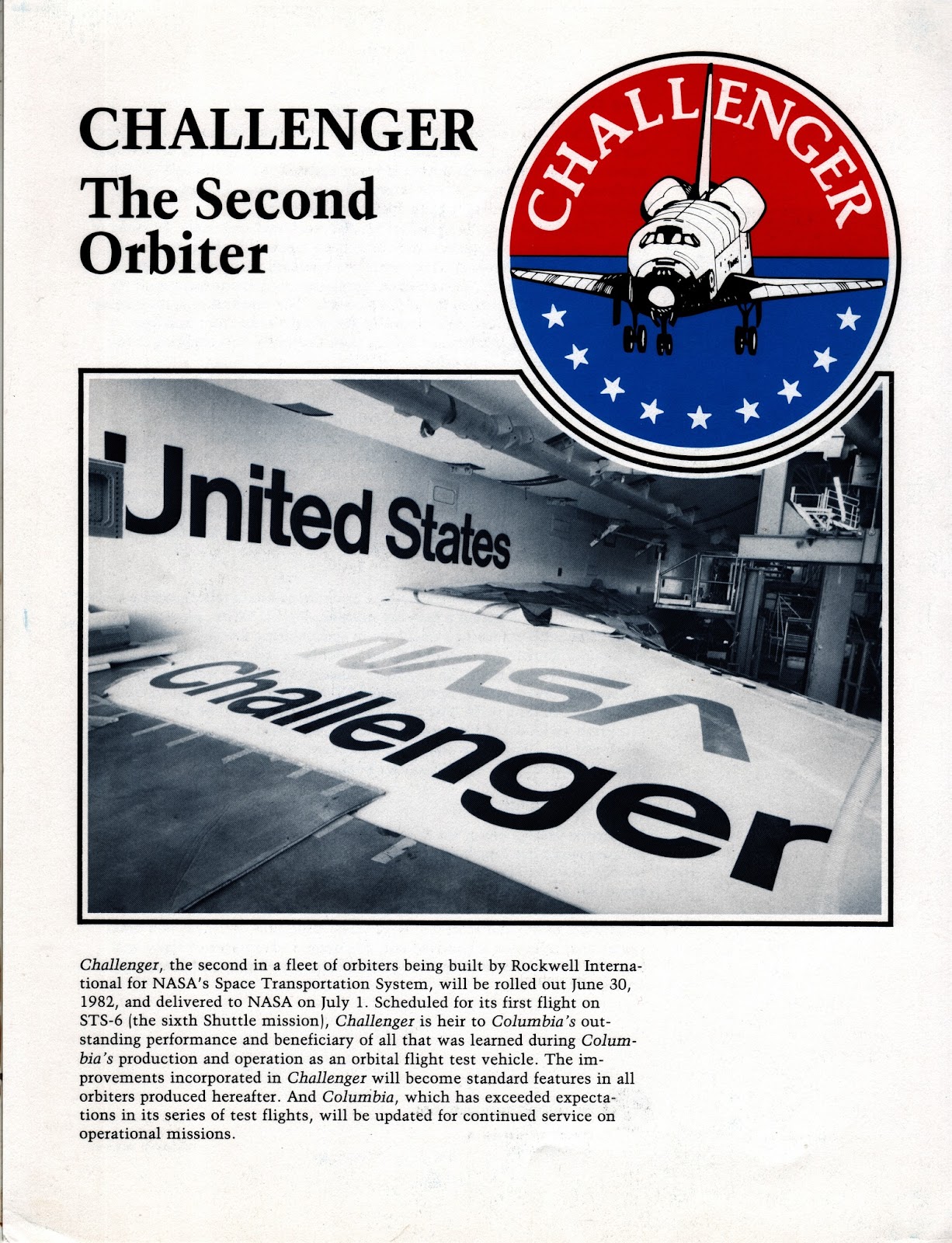
The following pamphlet was published by Rockwell International in June 1982 and might have been available to guests at the rollout:


Challenger is represented in my collection by a sample of fabric that was used to line the shuttle’s payload bay on her first mission, STS-6 in April 1983:


It is a cream-coloured piece of beta cloth 10 cm × 9 cm (4″ × 3½″) supplied to me by David Bryant of The Space Station in the UK, together with copies of the provenance of the sample from NASA to him. Note that this fabric was removed during routine servicing and is not debris from the destruction of the spacecraft in the accident of 28 January 1986 that claimed her and her crew on her tenth mission.

Although I prefer not to include material in these posts that is not actually in my collection, a photo from NASA’s archives provides a sombre epilogue this week.  Following the accident, divers from USS Opportune recovered a 2.9 m × 4.9 m (9′ 7″ × 16′) fragment of Challenger’s starboard wing with part of her name still visible, photographed when it was delivered to the Kennedy Space Center Logistics Facility on 18 April 1986:

STS51L-10187

This is the same section of wing visible in the Rockwell International pamphlet presented above, right under the heading “Challenger The Second Orbiter”.


Copyright information: the print of the worker painting Challenger’s name that I hold in my collection came from a news archive and is a work of Rockwell International, circulated to the media in 1982 without a copyright notice. The pamphlet is also a work of Rockwell International, dated 1982 and published without a copyright notice.  As works published in the United States prior to 1989 without such notices, these items would be in the public domain. If copyright still exists in these items, it would now belong to Boeing, and use here is claimed to be fair use for the purpose of education and commentary in a non-commercial setting as permitted by 17 U.S.C. § 107. The NASA photo is a work of the US federal government and therefore in the public domain.


Sunday, August 12, 2012

Space Shuttle Columbia strap and construction photos

This week, photos of space shuttle Columbia as she neared completion, and a relic—a strap that flew on the shuttle.

Columbia, OV-102, was the second space shuttle built, and the first to fly in space. She was named after the sloop on which Robert Gray undertook the first American circumnavigation of the world in 1790 and explored the Columbia River in 1792. Construction began on 27 March 1975 at the Rockwell International plant in Palmdale, California (today, part of Boeing) and almost four years later, on 24 March 1979, Columbia arrived at the Kennedy Space Center for final integration and testing prior to launch.

This series of photos shows workers at Kennedy in 1979 attaching some of the 34,000 tiles that formed Columbia’s thermal protection system (TPS)—or heatshield:

108-KSC-79P-119
108-KSC-79P-319
108-KSC-79P-118


Note the numbers printed on the tiles, which indicated their placement on the spacecraft.

On 16 July that year, the first of Columbia’s three engines (engine number 2006) was fitted to the orbiter:


108-KSC-79PC-294


The third and final engine (engine number 2007) was fitted on 4 August:

79-HC-425

Even as NASA was issuing these photos to the press, the agency remained optimistic that the shuttle would fly soon. The back of one of these prints states:

“Columbia, the first in a new breed of manned, reusable spacecraft, is being readied for the first launch of the Space Shuttle later this year.”
In fact, Columbia would not fly till April 1981.

Columbia is represented in my collection by a strap from the orbiter. Note that this strap was removed during routine servicing and is not debris from the destruction of the spacecraft in the accident of 2 February 2003 that claimed her and her crew.


The strap is made of fabric (beta cloth, I presume) with press studs fitted to either end. It is 168 mm long and 22 mm wide (6⅔″ × ⅞″). It’s stamped with the word “SCRAP” in red ink, although this is barely visible in this photo. The strap and its NASA scrap tag were supplied to me by David Bryant of The Space Station in the UK. Note Columbia’s number—OV-102—written on the tag.

While all the other relics in my collection are samples of various materials, this is a complete unit, and is therefore one of my very favourite pieces.


Copyright information: all five photos are works of NASA. As works of the US federal government, all are in the public domain. I’ve noted their NASA serial numbers under each photo. I do not believe that the scrap tag contains enough expressive content to be eligible for copyright protection, but if it did, it is also a work of the US federal government and would be in the public domain anyway.


Tuesday, June 26, 2012

Space Shuttle Enterprise insulation sample

This week, a photo of—and a physical relic from—the prototype Space Shuttle, Enterprise.

Construction work on NASA’s first Space Shuttle orbiter, serial OV-101, commenced on 4 June 1974 at the Rockwell International plant in Downey, California. (Rockwell International is today part of Boeing; the plant in Downey was closed in 1999.)

While development continued on the various shuttle subsystems, NASA planned to use this prototype for a variety of airframe tests before refitting her as an actual spacecraft. OV-101 was therefore constructed without engines or any of the associated plumbing for them. In place of the heat-shield tiles that form the thermal protection system (TPS) of an operational shuttle, she was fitted with blocks of polyurethane foam. On her nose, she carried a needle-like air data probe taken from a U-2 spyplane. This probe was to be used in aerodynamic tests of the orbiter in flight, both in “captive” mode mounted on a carrier aircraft, and flying free as a glider.

Although Enterprise was always destined for space, it eventually turned out to be easier and cheaper to refit NASA’s full-size engineering test airframe into a functional spacecraft than to refit Enterprise. Therefore, the shuttle program’s static test article (STA-099) became an orbiter (OV-099, Challenger) and Enterprise was destined for publicity tours and eventually to become a museum piece.

This photo shows the orbiter in 1983, being prepared for an appearance at that year’s Paris Air Show:


The following year, Enterprise appeared at the 1984 Louisiana World Exposition, and in 1985 was stripped of useful components in preparation for museum display. During this process, on 29 April 1985, insulation material was removed from Enterprise’s payload bay doors.

This is a small sample of that insulation, which I obtained from David Bryant of The Space Station in the UK, together with provenance tracing the ownership of the sample between NASA and him:


The insulation is matting made from some kind of fine synthetic fibre with some heavier strands running through it. Bright white, it has an almost silvery sheen. The box in which the sample lies is around 8 cm × 5.5 cm (3” × 2”). The accompanying scrapping paperwork from NASA identifies it as “Type III, 3 lb/ft3, 2300° F” (48 kg/m3, 1260° C).

Epilogue:
On 18 November 1985, Enterprise arrived in Washington DC and NASA transferred ownership to the Smithsonian National Air and Space Museum, marking the first space shuttle’s official retirement. She remained there on display until 27 April 2012, when shuttle Discovery took her place at the Smithsonian and Enterprise was transferred to the Intrepid Sea, Air & Space Museum in New York City.

Correction:
When I first published this post, I misidentified the photo as Enterprise undergoing final assembly at the Rockwell International plant in Palmdale, California, sometime in 1975 or 1976. Further research identified the correct point in Enterprise’s career, and the correct copyright status of the image.


Copyright information: the photo of Enterprise is  a NASA image, part of the Dryden Flight Research Center collection, serial EC83-24309. As a work of the US federal government, it is in the public domain. 

Thursday, April 26, 2012

Skylab 2 parasol sample from NASA MFA office

Here’s a tiny snippet of material used to solve a serious engineering problem in space. 


The Skylab 1 mission1 was the launch of America’s first space station. It was carried into orbit—without a crew—by a Saturn V rocket that the cancellation of the last few Apollo moon missions had left surplus. Skylab 2 was to launch one day later and carry the first astronauts to the station for a 28-day visit.

However, during the launch of the station on 14 May 1973, it became apparent that something had gone badly wrong. Engineers deduced that during launch, Skylab had lost its meteroid shield—the tube-like structure that encircled the main body of the station to protect it from debris and from the Sun’s heat. Without this protection, the temperature inside Skylab soon reached 38° C and was expected to go as high as 77° C.

The launch of Skylab 2 was postponed while equipment and procedures were developed to repair the station. A key feature of these repair efforts was a “parasol” that the astronauts could deploy through one of Skylab's airlocks and which would provide the station with protection from the Sun. The parasol fabric was orange nylon laminated to aluminized Mylar, manufactured for NASA by the G. T. Schjeldahl Company2 (today simply Sheldal) of Northfield, Minnesota.

The Skylab 2 crew launched on 25 May and successfully deployed the parasol the following day. Within a few days, the interior temperature stabilised at 26° C, making the station habitable and ensuring the safety of the supplies and experiments aboard.

To celebrate the success of the efforts, NASA’s Manned Flight Awareness Office issued laminated cards to employees that contained a small swatch of the parasol material (roughly 1 cm, or ½”, along each edge). The swatch was mounted on an image of Skylab taken by the Skylab 2 crew as they departed the station (NASA image 73-H-580), and clearly shows the parasol deployed. The card also bore the employee’s name (which I've blurred out here for their privacy), a message of congratulations, and facsimiles of the autographs of the nine Skylab astronauts.

The back of the card features another view of Skylab with the parasol in place (NASA image 73-H-578)—also taken by the departing Skylab 2 crew—overlaid with small portraits of all nine astronauts.


Footnotes:
1 Skylab mission numbering is a little problematic. In this post, I’m following the scheme preferred by NASA headquarters—Skylab 1 was the launch of the station, followed by Skylab 2, 3, and 4, each of which took a crew of three astronauts up to it. Skylab Program management used a different scheme: they didn’t number the station launch, and used Skylab 1, 2, and 3 to refer to the three flights with a crew. Note that the front of this card uses this latter scheme.
2 Wikipedia informs me that company founder Gilmore T. Schjeldahl (1 June 1912 – 10 March 2002) ‘may be best known for inventing the plastic-lined airsickness bag’.

Copyright information: the Skylab photos, astronaut portraits, and card design and text are all works of NASA. As works of the US federal government, all are in the public domain.