Showing posts with label press kit. Show all posts

Thursday, July 19, 2012

Space Shuttle Approach and Landing Test 5 press kit items from DFRC

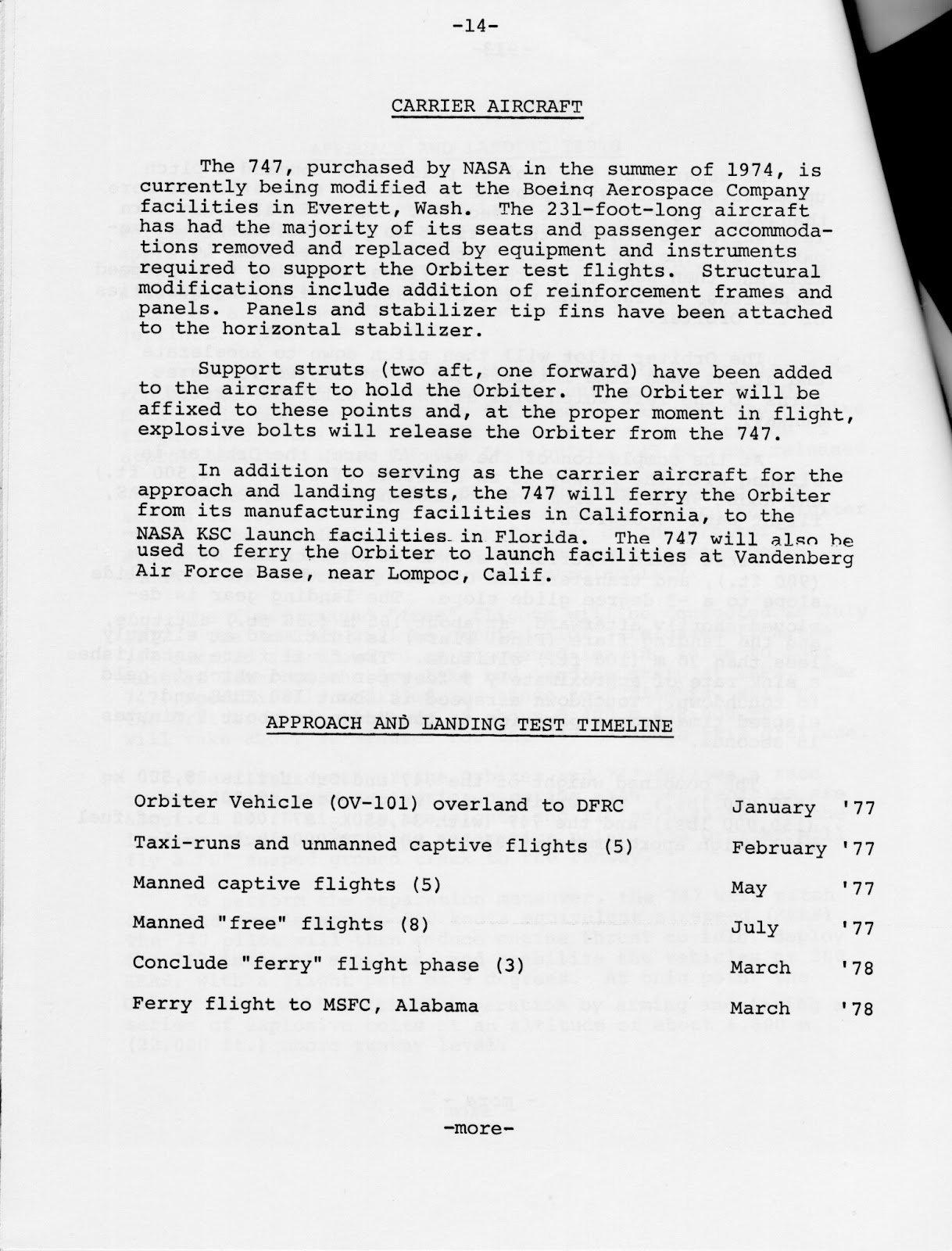
This week I present the press kit from space shuttle Enterprise’s fifth and final free flight.

Before the space shuttle commenced operations, NASA validated the airworthiness of the orbiter design in a series of  test flights. The initial flights were “captive” tests, mounted on the Shuttle Carrier Aircraft (SCA), NASA’s modified Boeing 747. From 12 August 1977, the captive flights were followed by five free flights in which Enterprise was released from her mother ship to fly free to a landing at Edwards Air Force Base in the Californian desert. 

NASA planned that after these Approach and Landing Tests (ALT), Enterprise would spend a year undergoing vibration tests to verify other aspects of the shuttle design and would then be returned to Rockwell International (today part of Boeing) to be refurbished for orbital flight. This refurbishment never took place (a ground test airframe was refurbished instead to become Challenger) and the only times Enterprise took to the air again was as cargo atop the SCA on her way to various exhibition sites. These destinations included the 1983 Paris Air Show, the 1984 Louisiana World Exposition, the Smithsonian National Air and Space Museum, and the Intrepid Sea, Air & Space Museum, Enterprise’s current home.

Each of the Approach and Landing Tests was a little more ambitious than the one that went before. They began with Enterprise fitted with a streamlined tailcone covering the blunt rear end of the shuttle where the main engines were designed to fit, and with the shuttle descending to land on a dry lake bed with plenty of margin for error. By the fifth flight, of 26 October 1977, Enterprise was flying without the tailcone, with dummy main engines in place, and headed for touchdown on a conventional concrete runway.

It would be the worst landing of the whole shuttle program.

The NASA press release describes the test as planned for that day:


Coming in slightly fast, Enterprise missed the intended touchdown point, landed long, bounced back into the air, then started to roll before the crew brought her back down safely. 

This video shows the landing:


Lag in the responsiveness of the flight control system, together with the generally poor visibility from the Shuttle’s flight deck, had led the crew (commander Fred Haise and pilot Gordon Fullerton) into a series of overcorrections or “pilot-induced oscillation” (PIO). 

As a result, after this test, the flight control system software was modified to counteract the tendency for pilots to overcorrect in this way, at the expense of a little control sensitivity.


Copyright information: the press kit is a work of NASA. As a work of the US federal government, it is in the public domain. 


Thursday, July 12, 2012

Space Shuttle Approach and Landing Test 1 press kit items from DFRC

Sometimes real-world experience beats anything you can do in simulation. The space shuttle design relied on many bold design decisions, and the mode of the orbiter’s return to earth was one of the boldest of all.

All previous crewed spacecraft had been capsules that parachuted back to earth. However, after dropping out of orbit, the shuttle was to fly as a 100-tonne glider towards a landing on a conventional runway. The descent would be steep, and pilots would have only one chance to put the craft down safely. Although NASA considered fitting the shuttle with retractable jet engines, the agency’s experience with lifting bodies—wingless aircraft with a similarly steep rate of descent when flown as gliders—suggested that the weight of engines could be saved and that a steep glide was a perfectly feasible way to get the orbiter back on the ground. In 1977, NASA set out to prove this with the prototype shuttle, Enterprise in a series of approach and landing tests (ALT) at the Dryden Flight Research Center at Edwards Air Force Base in the Californian desert.1

The first of five flights took place on 12 August 1977. A few items from the press kit issued by NASA for the day set the scene.

This first item is a portrait of the crew assigned to the mission: Fred Haise (commander) and Gordon Fullerton (pilot). This is a standard 8″ × 10″ colour lithograph printed on card with a description on the back:


The second item is a pamphlet that describes the ALT program in general, together with an overview of the Space Shuttle system and the orbiter Enterprise in particular.


As described, the plan for the ALT program was as follows:
  1. Load the Enterprise on the back of a specially modified Boeing 747.2
  2. Carry it to an altitude of around 25,000 ft (7,600 metres).
  3. Release it from the 747.
  4. Pilot it back to earth. The shuttle would drop those 25,000 feet in a little over five minutes—around twice the rate of descent of a typical commercial jet flight.
This double-sided sheet provides details of the first free flight planned for 12 August 1977:


And finally, the schedule for the day for NASA guests staying at the Holiday Inn at Palmdale: on the bus at 5:30 AM to head out to Edwards Air Force Base; show over and heading back to Palmdale by 9:00 AM.


If you want to see the flight yourself, a video is available on YouTube. Enterprise separates from the carrier aircraft at around the 4′ 30″ mark, and touches down at around the 9′ 30″ mark.


Footnotes:
1 Prior to these tests, NASA conducted a series of flights with the shuttle mounted to its Boeing 747 carrier aircraft, initially without crew and without the shuttle’s systems powered up. Later flights had a crew aboard the shuttle and its systems active. NASA also made a series of flights with an F-104 Starfighter in close proximity to the 747 to explore the ability of the shuttle to separate cleanly from the carrier aircraft.
2 NASA had purchased its Boeing 747 from American Airlines in 1974 to use for aerodynamic research. In 1976, it returned this aircraft (registration N905NA) to Boeing for refurbishment as a carrier aircraft for the space shuttle.

Copyright information: all materials in this press kit were produced by NASA. As works of the US federal government, all are in the public domain. 

Thursday, July 5, 2012

Space Shuttle Enterprise rollout pass and press kit

On 12 March 1976, final assembly of NASA’s first space shuttle was completed at the Rockwell International plant in Palmdale, California (now part of Boeing). The shuttle bore the serial OV-101—for orbiter vehicle—and was originally to be named Constitution. Not only does this word have a special resonance for Americans, but the name has a long and proud heritage in the US Navy, and the shuttle was to be unveiled to the public on 17 September, Constitution Day.

However, Star Trek fans mobilised to ask the White House to name America’s first “real” (as in re-usable) spaceship after their beloved starship, Enterprise. John and Bjo Trimble, influential figures in the fan community, orchestrated a campaign which saw many thousands of letters sent. Estimates vary between 10,000 and 400,000, depending who you listen to.

On 7 September 1976, President Gerald Ford asked NASA Administrator James C. Fletcher to make the change, quipping “You know, I’m a little partial to the name Enterprise.”

This is a guest pass for the roll-out ceremony, which took place as scheduled ten days later, on 17 September:


It’s printed on thin card, on one side only, and measures 10 cm × 6.5 cm (4” × 2½”). The illustration is curious: it’s adapted from concept art of the shuttle being pushed out of the hangar in which it was constructed; this art appears on the NASA press kit for the event described below. However, as adapted here, it supposedly indicates the shuttle being towed out into the open, but shows the tractor driver still facing backwards. Note too the impossible shadows: the shadows under the tractor and shuttle confirm that the spacecraft is being towed out into the light of day, but the front half of the orbiter fuselage is in shadow, and the rear fuselage (still inside the darkened hangar) is illuminated.

The press kit for the event is thirty pages long and is printed on flimsy government-letter-sized paper. My copy is bound with a single staple in a position that makes opening it fully for scanning very difficult without damaging the document. I’ve included a few of the most interesting pages as a sample here.


I don’t normally post images on this blog that aren’t part of my collection itself, but as a dedicated Star Trek fan, I need to finish the story of the shuttle’s roll-out and this picture says it all really:

source: http://www.nasa.govStar Trek/multimedia/imagegallery/image_feature_1204.html
The name Enterprise is clearly visible on the shuttle’s side. Pictured in front of her are most of the Star Trek cast. Left to right are: NASA Administator James C. Fletcher, DeForest Kelley (Dr. McCoy), George Takei (Lt. Sulu), James Doohan (Scotty), Nichelle Nichols (Lt. Uhura), Leonard Nimoy (Mr. Spock), Gene Roddenberry (Star Trek’s creator), an unidentified NASA official, and Walter Koenig (Mr. Chekov). Note that they are wearing badges similar in design to the one at the top of this post, but theirs appear beige instead of blue.

And when the Enterprise finally rolled out of her hangar, the US Air Force band struck up the theme music from Star Trek.

In 1979, the first Star Trek film (simply titled Star Trek: The Motion Picture) repaid the favour. The recreation deck of the starship Enterprise is shown to feature depictions of earlier vessels to bear the name—the space shuttle among them (centre):


Art imitating life imitating art!


Afterword:
Those who know me know how much I abhor the movie that JJ Abrams released in 2009, named after Star Trek. It might be a reasonable action film (that’s not a genre I generally enjoy, so I don’t feel that I can fairly judge it on that count) but I think it fails as science fiction and fails badly as Star Trek. Among the saddest things about the film are its summer-blockbuster disposability and its complete lack of vision. Abrams’ attempt at Star Trek will never inspire anybody to don a pair of rubber ears, let alone campaign to have a spaceship renamed.


Copyright information: the guest pass, press kit, and photo of the Star Trek cast at the roll-out are all works of NASA, and as works of the US federal government, all are in the public domain. Copyright on the image from Star Trek: The Motion Picture belongs to Paramount Pictures. I claim that use here is fair use for the purposes of education and commentary, as permitted under 17 U.S.C. § 107.

Saturday, May 26, 2012

Apollo-Soyuz Test Project press kit items from NASA JSC

In July 1975, an American Apollo spacecraft docked with a Soviet Soyuz spacecraft for two days of joint scientific experiments. Before and after the docking, the two spacecraft manœuvered around each other and made additional dockings and undockings to give their crews and ground controllers experience with joint operation of these two very different craft. The Apollo–Soyuz Test Project (ASTP; in Russian, Экспериментальный полёт «Аполлон» — «Союз», or ЭПАС) stands out as a triumph of international scientific co-operation and goodwill against the backdrop of the Cold War. A few items from the press kit issued by NASA’s Johnson Space Center (JSC) provide an introduction to this landmark mission:

This first item is a small slip of paper, 6 cm × 15 cm (4½” × 6”) with the background and objectives of the mission explained on both sides. It’s printed on a lightweight beige stock with a linen face. I particularly like the 1970s typography in the title.

It begins:
“Three years of combined effort by the world’s leading space powers will culminate with dual launches for the first international manned space flight, the result of a May 1972 US–USSR agreement to design and test a compatible docking system for future spacecraft and space stations.

A milestone in international space cooperation, the Apollo Soyuz Test Project calls for the docking of a US Apollo and a USSR Soyuz in Earth orbit to test jointly designed rendezvous and docking equipment and procedures. The test lays the groundwork for future activities involving manned spacecraft of the two nations, and may help to make space rescues possible in years to come.”

It would take twenty years, but the hopes expressed in these paragraphs would prove fruitful. The Androgynous Peripheral Attach System (APAS) docking mechanism designed for this mission would provide the basis for the American Space Shuttle to dock with the Russian Mir space station and later with the International Space Station.1

The second item is a card, 18 cm × 13 cm (7” × 5”) that contains the schedule for the mission, as at 23 May 1975. It includes four alternate date ranges for successive days in July in case the launch did not occur as planned on 15 July (as it happened, the mission ran to schedule).


The third item is a card, 26.5 cm × 20 cm (10½” × 8”) that presents the mission profile in graphical form, beginning with the launch of the Soyuz spacecraft from Kazakhstan, and finishing with the splashdown of the Apollo spacecraft in the Pacific Ocean. The text throughout is in both English and Russian.


The back of the card presents an information summary of all2 American human spaceflights up to that time, covering the Mercury, Gemini, Apollo, and Skylab programs: thirty missions with a total cumulative time in space of 21,851 person hours!


Footnotes:
1The docking mechanism of the Chinese Shenzhou spacecraft is designed to be compatible with APAS too, making dockings of Shenzhou and the International Space Station technically feasible.
2The summary is not quite complete. It includes the two sub-orbital flights carried out as part of the Mercury Program (Mercury-Redstone 3 and Mercury-Redstone 4) but excludes thirteen sub-orbital flights of the X-15 rocket plane that, between 1962 and 1968, met the American definition for a spaceflight that was then in use. As defined in the US at the time, a spaceflight was any flight that reached an altitude of 50 miles (80 km). Furthermore, two of these flights—flight 90 and 91, both made by Joe Walker—also met the international definition for a spaceflight (a flight reaching an altitude of 100 km—62 miles). If the Mercury-Redstone flights were spaceflights, the X-15 flights were too. The incredible X-15 is sadly a too-often overlooked chapter of spaceflight history.


Copyright information: These three items come from a NASA press kit. The schedule and the profile are clearly NASA publications and, as works of the US federal government, are in the public domain. The mission schedule card is US Government Printing Office publication 1975—671-549/13 and the mission profile card carries the NASA image number S-74-3297. The small overview sheet does not provide any publication details, so at the very least, as a publication in the United States before 1989 without a copyright notice, it would be in the public domain anyway, even if it were not a federal government publication.


Saturday, May 5, 2012

Skylab 3 press kit from the US DoD

This week’s artifact is a press kit issued by the United States Department of Defense to describe the contribution of the military to the Skylab 3 mission. Probably the most visible role was that of the recovery forces: prior to the Space Shuttle, American spacecraft landed (“splashed down”) in the ocean. The astronauts and their capsule were recovered by helicopter and brought aboard an aircraft carrier waiting nearby.

However, as the press kit points out, the military involvement went far beyond recovering the spacecraft. Throughout Skylab 3’s launch and return, 2,260 members of the United States Air Force and United States Navy provided tracking, communications, safety, rescue, and meteorological services. Three ships and 51 aircraft were assigned to these efforts: a sizeable undertaking.

To most people, perhaps the most interesting thing about the document is how incredibly crude its production appears by today’s standards. The document itself is sixty pages of heavy stock in the old government letter size of 8” × 10½” (203 mm × 267 mm). Black-and-white printing appears on one side of the page only.

In 2012, any crank who hands out flyers on a street corner has slicker-looking material than the US Department of Defense was producing only forty years ago. Conversely, I’m struck by how closely some vintage sci-fi fanzines from the same era in my collection resemble this press kit: those amateurs were doing some impressive work.

One day, I’d like to scan the entire document for posterity, but the stapled binding on my copy is very tight, and getting good scans without damaging it will be a time-consuming challenge. For now, here are a few representative pages that deal with the recovery effort by USS New Orleans off the coast of California. New Orleans was flagship of Task Force 130, based at Pearl Harbor under Rear Admiral John L. Butts, Jr.


Copyright information: The text and images in this press kit are the work of the United States federal government, and therefore in the public domain.