Showing posts with label causeway pass. Show all posts

Wednesday, September 26, 2012

STS-41-B causeway pass and brochure

This week, some mementos from Space Shuttle mission STS-41-B (originally designated STS-11)1 which launched on 3 February 1984.

STS-41-B was Space Shuttle Challenger’s fourth trip to space, and the tenth shuttle flight overall.2 In most ways, it was an absolutely typical early-80s shuttle mission. The main objectives were to deliver two unremarkable Hughes HS-3763 commercial communication satellites to orbit: Westar 6 for Western Union (which later sold off its satellite business, today owned by Westar) and Palapa B2 for Indosat.4

What made the flight unforgettable, though, was the first flight of the Manned Maneuvering Unit (MMU)—a personal propulsion system like an oversized backpack built for NASA by Martin Marietta (today part of Lockheed Martin). The MMU allowed astronauts to manœuver independently in space, untethered and away from their spacecraft. Astronaut Bruce McCandless’s first test of the system on 7 February provided one of the iconic images of the shuttle program:

NASA image S84-27017


The MMU deserves a post of its own sometime in the future. For today, I’ll focus on the mission itself.

This brochure, issued by the shuttle’s manufacturer, Rockwell International (today, part of Boeing) in January 1984 describes the mission objectives, the cargo, and the crew:


Apart from discussing the communication satellites and the MMU, the brochure also outlines the dress rehearsal conducted during the mission for a satellite rescue to be performed on the next flight. When actually realised, this part was truly deserving of Rockwell’s advertising hype “Another Stride in America’s Space Capabilites”. Putting satellites in orbit was well-established technology, but on STS-41-C, NASA would attempt to repair one in orbit. But back to STS-41-B...

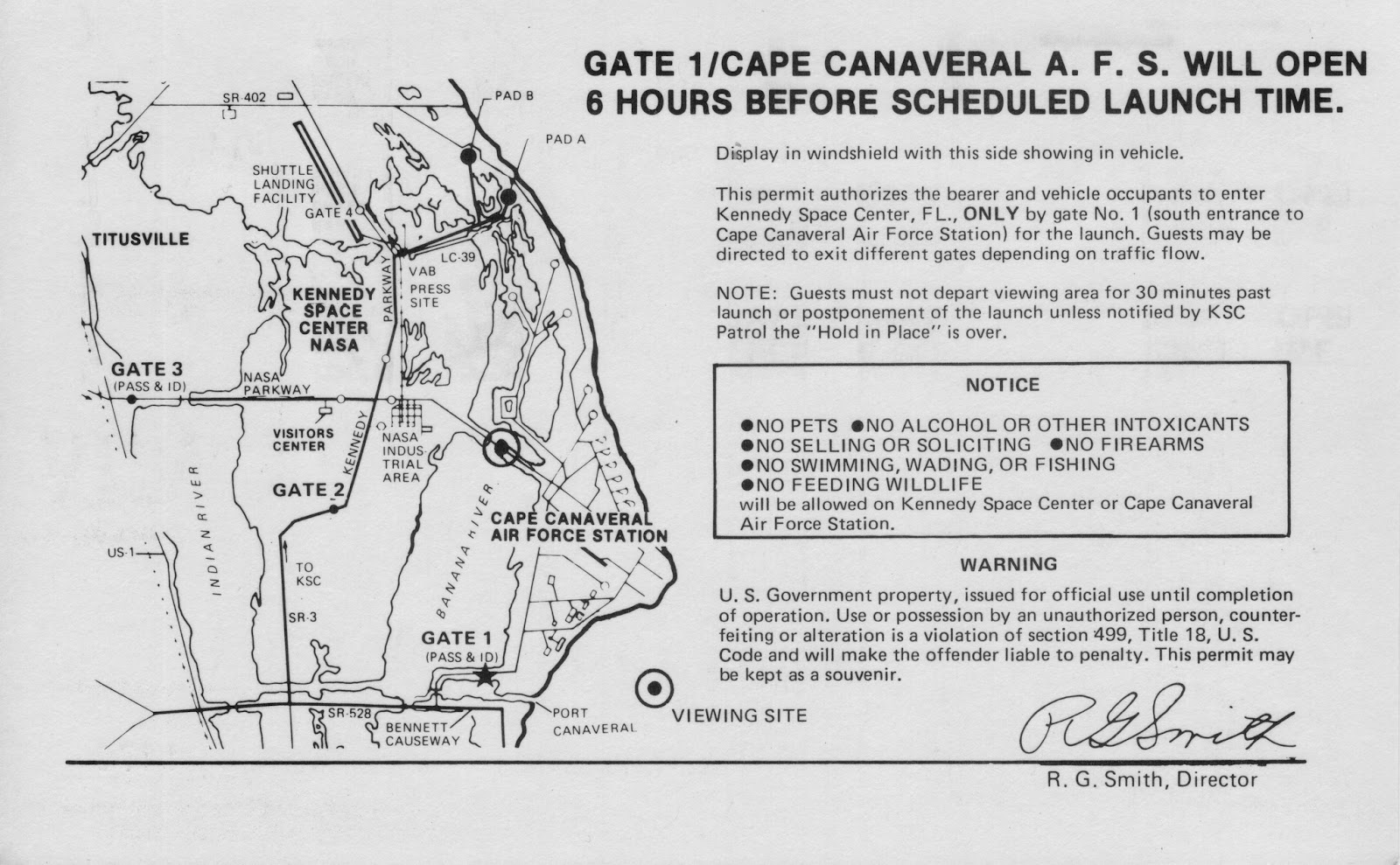
This pass allowed a spectator’s vehicle onto the NASA Causeway to watch the STS-41-B launch. Ten kilometres (six miles) from the launch pad, this was the closest that the public could get.


The pass itself is a fluorescent pink, that unfortunately my scanner reduces to the pale salmon you see here. It’s also in much poorer condition than the other passes in my collection. Please let me know if you’ve got a better one that you’re prepared to part with!

Footnotes:
1 From this, the tenth shuttle flight, through to the twenty-fifth, NASA abandoned its previous scheme of identifying shuttle missions simply by the prefix “STS” (for Space Transportation System, the official name of the shuttle program) followed by the number of the flight. Instead, the agency adopted a code of two digits and a letter. The first digit represented the financial year from which the budget for the flight came. The second digit represented the launch site for the mission (“1” for the Kennedy Space Center in Florida, “2” for Vandenberg Air Force Base, California). The final letter represented the number of the flight in that financial year, so STS-41-B was followed by STS-41-C and STS-41-D. Shuttle flights for 1984, 1985, and 1986 followed this designation scheme. No shuttles ever launched from Vandenberg, so “1” was the only second digit ever used.

2 The mission that would have been designated STS-10 was cancelled due to delays with its payload. It was later flown as STS-51-C.

3 Hughes is today part of Boeing.

4 Both launches failed and the satellites were trapped in useless orbits. They were retrieved for their insurers in November 1984 by shuttle mission STS-51-A. Both were subsequently refurbished, resold, and successfully reflown on separate expendable launch vehicles in 1990.


Copyright information: the brochure is a work of Rockwell International and does not carry a copyright notice. As a work published in the United States prior to 1989 without such a notice, it is in the public domain. The MMU photograph and the pass are works of NASA. As works of the United States federal government, they too are  in the public domain.


Wednesday, September 19, 2012

STS-9 causeway pass and brochure

Spacelab was a collection of laboratory modules that could be carried in the space shuttle’s cargo bay. The system was built by the ESA (the European Space Agency) as a result of a co-operative agreement with NASA that dated back to 1973. It features very prominently in my memories of the early shuttle program, because it was the payload most frequently depicted. Spacelab seemed to appear in every shuttle-related book illustration, poster, model kit, or toy. The casual observer could have been forgiven for thinking that a particular combination of Spacelab modules was an integral part of the shuttle; a notion completely antithetical to its versatile design.

I’ll present some payload-specific memorabilia another time, but this week, I’ve got some mementos of STS-9. This mission was the first to carry Spacelab to orbit, and launched in November 1983 with the space shuttle Columbia on her sixth flight.

This brochure, issued by the shuttle’s manufacturer, Rockwell International (today, part of Boeing) in October 1983 introduces the mission and its crew:


The brochure contains an interesting inconsistency. The six-page brochure issued for STS-6 earlier in the year has two sidebars; one titled “Mission Log” with a summary of previous shuttle flights, and the other titled “Mission Profile” with a summary of the mission itself. The STS-9 brochure has an equivalent section titled “STS-9 Mission Log”, which to me suggests it should outline the schedule for the mission. It also uses similar graphics to the STS-6 “Mission Profile” but correct for STS-9, including revealing Spacelab to space. However, the text is just summary of the previous eight missions. I wonder if the two sections were condensed into one during preparation of the brochure, perhaps to save pages?

The brochure mentions Rockwell International’s role in readying Columbia for the mission, but somehow does not mention that the NASA contract for integrating Spacelab into the shuttle’s systems went to rival McDonnell Douglas (today, also part of Boeing).

The second item this week is a pass that allowed a spectator’s vehicle onto the NASA Causeway to watch the STS-9 launch. Ten kilometres (six miles) from the launch pad, this was the closest that the public could get.


The pass itself is a fluorescent green, which unfortunately my scanner doesn’t capture well.


Copyright information: the brochure is a work of Rockwell International and does not carry a copyright notice. As a work published in the United States prior to 1989 without such a notice, it is in the public domain. The pass is a work of NASA. As a work of the United States federal government, it too is in the public domain.


Wednesday, September 12, 2012

STS-6 causeway pass and brochure

This week, some mementos of the first launch of Space Shuttle Challenger.

The Space Shuttle program’s journeys into space commenced with a series of four orbital flight tests and one operational mission conducted with Columbia in 1981 and 1982. Following these flights, Columbia was refurbished for the first Spacelab mission while operational flights continued with a new orbiter — Challenger. Challenger’s first mission was STS-6, launched on 4 April 1983.

The main objective of the mission was to deploy the first of a series of new space communication satellites: the Tracking and Data Relay Satellites (TDRS). This system was to relay telemetry from spacecraft to tracking stations on the ground, increasing the length of time and the frequency with which spacecraft were in contact with Earth, and also the sheer volume of data that could be transferred during these contacts.

This brochure, issued by the shuttle’s manufacturer, Rockwell International (today, part of Boeing) in February 1983 describes the new orbiter, outlines the mission profile for STS-6, and introduces the crew:


The brochure concludes with a very optimistic section titled “The Emergence of a Spaceline”. As originally conceived in the late 1960s, the space shuttle should have launched nearly weekly. These expectations were gradually eroded, although as the program commenced, the shuttle was still intended to replace all other launch vehicles then in use by the United States. The Rockwell brochure does not give specifics about the frequency of flights, but says more generally:
“Turning this technical triumph into a commercial success depends on getting most out of Shuttle capabilities: each orbiter must be reflown as quickly as possible within safety requirements to establish cost-effective operations that attract commercial users.... Soon, the takeoff and landing of Shuttle orbiters will be almost as common as the coming and going of commercial aircraft.”
Sadly, this was extremely wishful thinking, and the largest number of shuttle launches conducted in any year was the nine flights made in 1985.

This pass allowed a spectator’s vehicle onto the NASA Causeway to watch the STS-6 launch. Ten kilometres (six miles) from the launch pad, this was the closest that the public could get to the pad.


The pass itself is a fluorescent orange, that unfortunately my scanner reduces to the pale salmon you see here.


Copyright information: the brochure is a work of Rockwell International and does not carry a copyright notice. As a work published in the United States prior to 1989 without such a notice, it is in the public domain. The pass is a work of NASA. As a work of the United States federal government, it too is in the public domain.


Sunday, August 19, 2012

STS-1 causeway pass and brochure

This week, some mementos of the first space shuttle launch.

On 12 April 1981—the twentieth anniversary of the first human spaceflight—space shuttle Columbia launched on STS-1, the first orbital test flight of the Space Transportation System. The flight was originally intended to have taken place in June 1979.

Thirty years later, it’s perhaps easy to forget just how revolutionary the space shuttle was, how utterly unlike any previous spacecraft. The delays in the program were due to the need to develop completely new technologies that a re-usable spacecraft demanded. Two key technologies that accounted for a large proportion of the delays were a heat shield that would not be sacrificed during re-entry, and engines that could be fired around fifty times when all previous similar engines were designed to be fired just once.

This brochure, issued by the Kennedy Space Center, describes the space shuttle, outlines the mission profile for STS-1, and introduces the crew:


This pass allowed a spectator’s vehicle onto the NASA Causeway to watch the launch. Ten kilometres (six miles) from the launch pad, this was the closest that the public could get to the pad.


Today, in 2012, there’s a certain amount of hand-wringing that NASA does not presently have human spaceflight capability, despite the work currently proceeding on various designs for the Commercial Crew Program and on the Orion multi-purpose crew vehicle. It’s worth remembering that by the time STS-1 launched, America had been without human spaceflight capability for nearly six years—the last flight had been the Apollo–Soyuz Test Project of July 1975.


Copyright information: the brochure and pass are works of NASA. As works of the United States federal government, they are in the public domain.