Spacelab was a collection of laboratory modules that could be carried in the space shuttle’s cargo bay. The system was built by the ESA (the European Space Agency) as a result of a co-operative agreement with NASA that dated back to 1973. It features very prominently in my memories of the early shuttle program, because it was the payload most frequently depicted. Spacelab seemed to appear in every shuttle-related book illustration, poster, model kit, or toy. The casual observer could have been forgiven for thinking that a particular combination of Spacelab modules was an integral part of the shuttle; a notion completely antithetical to its versatile design.
I’ll present some payload-specific memorabilia another time, but this week, I’ve got some mementos of STS-9. This mission was the first to carry Spacelab to orbit, and launched in November 1983 with the space shuttle Columbia on her sixth flight.
This brochure, issued by the shuttle’s manufacturer, Rockwell International (today, part of Boeing) in October 1983 introduces the mission and its crew:
The brochure contains an interesting inconsistency. The six-page brochure issued for STS-6 earlier in the year has two sidebars; one titled “Mission Log” with a summary of previous shuttle flights, and the other titled “Mission Profile” with a summary of the mission itself. The STS-9 brochure has an equivalent section titled “STS-9 Mission Log”, which to me suggests it should outline the schedule for the mission. It also uses similar graphics to the STS-6 “Mission Profile” but correct for STS-9, including revealing Spacelab to space. However, the text is just summary of the previous eight missions. I wonder if the two sections were condensed into one during preparation of the brochure, perhaps to save pages?
The brochure mentions Rockwell International’s role in readying Columbia for the mission, but somehow does not mention that the NASA contract for integrating Spacelab into the shuttle’s systems went to rival McDonnell Douglas (today, also part of Boeing).
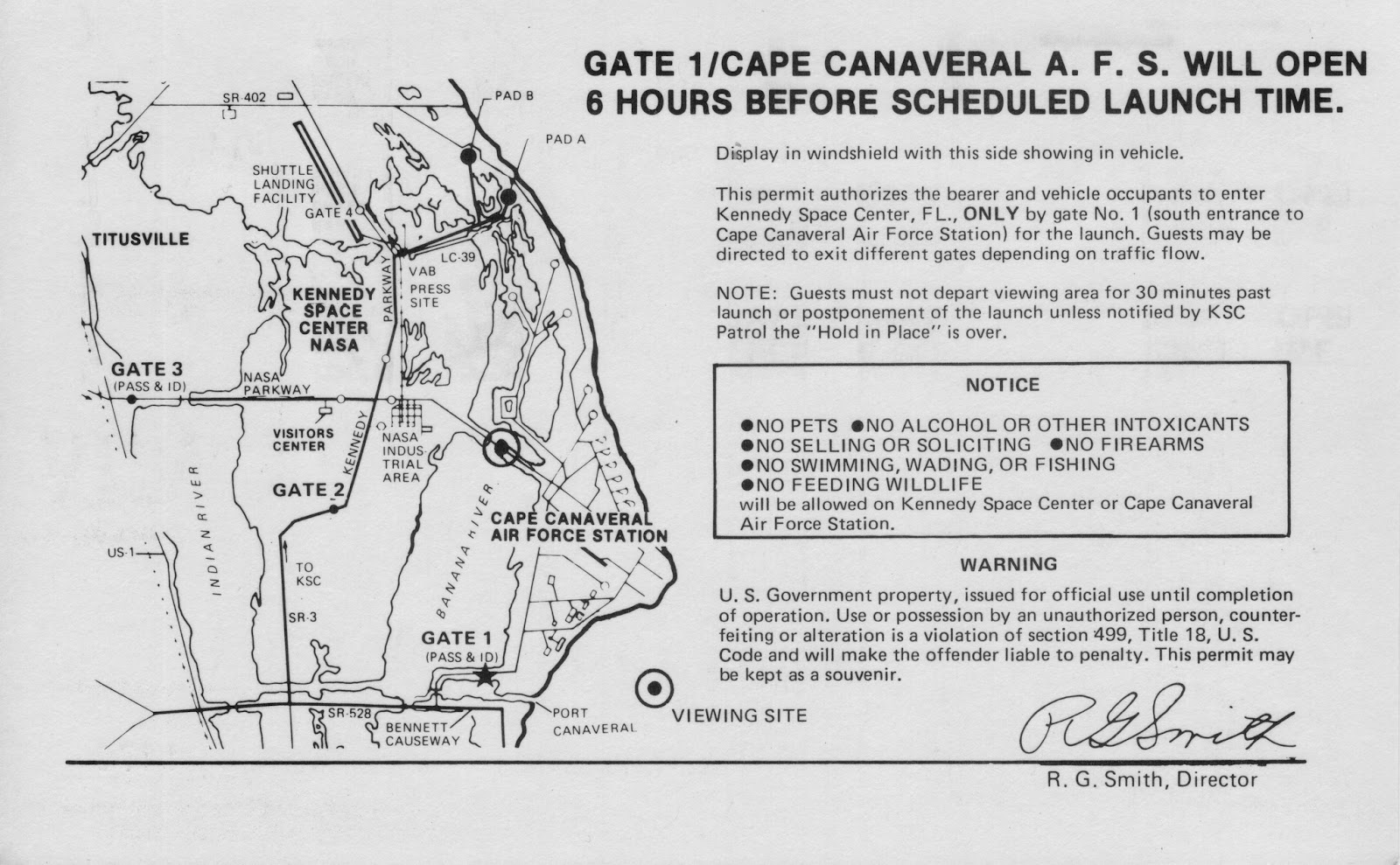
The second item this week is a pass that allowed a spectator’s vehicle onto the NASA Causeway
to watch the STS-9 launch. Ten kilometres (six miles) from the launch
pad, this was the closest that the public could get.
The pass itself is a fluorescent green, which unfortunately my scanner doesn’t capture well.
Copyright
information: the brochure is a work of Rockwell International and does
not carry a copyright notice. As a work published in the United States
prior to 1989 without such a notice, it is in the public domain. The
pass is a
work of NASA. As a work of the United States federal government, it too
is in the public domain.
Showing posts with label Columbia. Show all posts
Wednesday, September 19, 2012
Sunday, August 19, 2012
STS-1 causeway pass and brochure
This week, some mementos of the first space shuttle launch.
On 12 April 1981—the twentieth anniversary of the first human spaceflight—space shuttle Columbia launched on STS-1, the first orbital test flight of the Space Transportation System. The flight was originally intended to have taken place in June 1979.
Thirty years later, it’s perhaps easy to forget just how revolutionary the space shuttle was, how utterly unlike any previous spacecraft. The delays in the program were due to the need to develop completely new technologies that a re-usable spacecraft demanded. Two key technologies that accounted for a large proportion of the delays were a heat shield that would not be sacrificed during re-entry, and engines that could be fired around fifty times when all previous similar engines were designed to be fired just once.
This brochure, issued by the Kennedy Space Center, describes the space shuttle, outlines the mission profile for STS-1, and introduces the crew:
This pass allowed a spectator’s vehicle onto the NASA Causeway to watch the launch. Ten kilometres (six miles) from the launch pad, this was the closest that the public could get to the pad.
Today, in 2012, there’s a certain amount of hand-wringing that NASA does not presently have human spaceflight capability, despite the work currently proceeding on various designs for the Commercial Crew Program and on the Orion multi-purpose crew vehicle. It’s worth remembering that by the time STS-1 launched, America had been without human spaceflight capability for nearly six years—the last flight had been the Apollo–Soyuz Test Project of July 1975.
Copyright information: the brochure and pass are works of NASA. As works of the United States federal government, they are in the public domain.
On 12 April 1981—the twentieth anniversary of the first human spaceflight—space shuttle Columbia launched on STS-1, the first orbital test flight of the Space Transportation System. The flight was originally intended to have taken place in June 1979.
Thirty years later, it’s perhaps easy to forget just how revolutionary the space shuttle was, how utterly unlike any previous spacecraft. The delays in the program were due to the need to develop completely new technologies that a re-usable spacecraft demanded. Two key technologies that accounted for a large proportion of the delays were a heat shield that would not be sacrificed during re-entry, and engines that could be fired around fifty times when all previous similar engines were designed to be fired just once.
This brochure, issued by the Kennedy Space Center, describes the space shuttle, outlines the mission profile for STS-1, and introduces the crew:
This pass allowed a spectator’s vehicle onto the NASA Causeway to watch the launch. Ten kilometres (six miles) from the launch pad, this was the closest that the public could get to the pad.
Today, in 2012, there’s a certain amount of hand-wringing that NASA does not presently have human spaceflight capability, despite the work currently proceeding on various designs for the Commercial Crew Program and on the Orion multi-purpose crew vehicle. It’s worth remembering that by the time STS-1 launched, America had been without human spaceflight capability for nearly six years—the last flight had been the Apollo–Soyuz Test Project of July 1975.
Copyright information: the brochure and pass are works of NASA. As works of the United States federal government, they are in the public domain.
Labels:
1981,
brochure,
causeway pass,
Columbia,
KSC,
Space Shuttle,
STS-1
Sunday, August 12, 2012
Space Shuttle Columbia strap and construction photos
This week, photos of space shuttle Columbia as she neared completion, and a relic—a strap that flew on the shuttle.
Columbia, OV-102, was the second space shuttle built, and the first to fly in space. She was named after the sloop on which Robert Gray undertook the first American circumnavigation of the world in 1790 and explored the Columbia River in 1792. Construction began on 27 March 1975 at the Rockwell International plant in Palmdale, California (today, part of Boeing) and almost four years later, on 24 March 1979, Columbia arrived at the Kennedy Space Center for final integration and testing prior to launch.
This series of photos shows workers at Kennedy in 1979 attaching some of the 34,000 tiles that formed Columbia’s thermal protection system (TPS)—or heatshield:
Note the numbers printed on the tiles, which indicated their placement on the spacecraft.
On 16 July that year, the first of Columbia’s three engines (engine number 2006) was fitted to the orbiter:
The third and final engine (engine number 2007) was fitted on 4 August:
Even as NASA was issuing these photos to the press, the agency remained optimistic that the shuttle would fly soon. The back of one of these prints states:
Columbia is represented in my collection by a strap from the orbiter. Note that this strap was removed during routine servicing and is not debris from the destruction of the spacecraft in the accident of 2 February 2003 that claimed her and her crew.
The strap is made of fabric (beta cloth, I presume) with press studs fitted to either end. It is 168 mm long and 22 mm wide (6⅔″ × ⅞″). It’s stamped with the word “SCRAP” in red ink, although this is barely visible in this photo. The strap and its NASA scrap tag were supplied to me by David Bryant of The Space Station in the UK. Note Columbia’s number—OV-102—written on the tag.
While all the other relics in my collection are samples of various materials, this is a complete unit, and is therefore one of my very favourite pieces.
Copyright information: all five photos are works of NASA. As works of the US federal government, all are in the public domain. I’ve noted their NASA serial numbers under each photo. I do not believe that the scrap tag contains enough expressive content to be eligible for copyright protection, but if it did, it is also a work of the US federal government and would be in the public domain anyway.
Columbia, OV-102, was the second space shuttle built, and the first to fly in space. She was named after the sloop on which Robert Gray undertook the first American circumnavigation of the world in 1790 and explored the Columbia River in 1792. Construction began on 27 March 1975 at the Rockwell International plant in Palmdale, California (today, part of Boeing) and almost four years later, on 24 March 1979, Columbia arrived at the Kennedy Space Center for final integration and testing prior to launch.
This series of photos shows workers at Kennedy in 1979 attaching some of the 34,000 tiles that formed Columbia’s thermal protection system (TPS)—or heatshield:
![]() |
| 108-KSC-79P-119 |
![]() |
| 108-KSC-79P-319 |
![]() |
| 108-KSC-79P-118 |
Note the numbers printed on the tiles, which indicated their placement on the spacecraft.
On 16 July that year, the first of Columbia’s three engines (engine number 2006) was fitted to the orbiter:
![]() |
| 108-KSC-79PC-294 |
The third and final engine (engine number 2007) was fitted on 4 August:
![]() |
| 79-HC-425 |
Even as NASA was issuing these photos to the press, the agency remained optimistic that the shuttle would fly soon. The back of one of these prints states:
In fact, Columbia would not fly till April 1981.
“Columbia, the first in a new breed of manned, reusable spacecraft, is being readied for the first launch of the Space Shuttle later this year.”
Columbia is represented in my collection by a strap from the orbiter. Note that this strap was removed during routine servicing and is not debris from the destruction of the spacecraft in the accident of 2 February 2003 that claimed her and her crew.
The strap is made of fabric (beta cloth, I presume) with press studs fitted to either end. It is 168 mm long and 22 mm wide (6⅔″ × ⅞″). It’s stamped with the word “SCRAP” in red ink, although this is barely visible in this photo. The strap and its NASA scrap tag were supplied to me by David Bryant of The Space Station in the UK. Note Columbia’s number—OV-102—written on the tag.
Copyright information: all five photos are works of NASA. As works of the US federal government, all are in the public domain. I’ve noted their NASA serial numbers under each photo. I do not believe that the scrap tag contains enough expressive content to be eligible for copyright protection, but if it did, it is also a work of the US federal government and would be in the public domain anyway.
Subscribe to:
Posts (Atom)