Tuesday, June 19, 2012

Early Space Shuttle concept art

Even before the Apollo program landed astronauts on the moon, NASA began firm plans for a re-usable spacecraft that would make regular trips into low-earth orbit. The original purpose for such a vehicle was to service a space station that would support further human spaceflight endeavours. These plans included establishing a permanent human presence on the moon, and landing a crew on Mars by the early 1980s.

On 29 January 1969, NASA awarded a first round of contracts to American aerospace manufacturers to define what form this re-usable spacecraft—initially designated the integral launch and reentry vehicle (ILRV)—might take. Over the next three years, NASA evaluated multiple designs as the agency refined the Space Shuttle concept. Some prints in my collection illustrate but a few of those proposals:


This design was one of the earliest; the work of Max Faget at NASA, who called it the DC-3 as an homage to the legendary airliner that revolutionised air travel in the 1930s. The design was similar in general layout to a conventional transport aircraft and much simpler than the exotic spaceplanes that the aerospace industry was proposing for the ILRV. The North American Rockwell Corporation (today, part of Boeing) took up Faget’s approach and earned a development contract for the design in December 1969.

The basic Space Shuttle concept is evident here: a winged spaceplane that lands on an ordinary runway instead of parachuting down like all previous spacecraft had. Note the large payload bay doors in the spine: a feature defined at the very beginning that would persist right through the design process.

The DC-3 was eventually doomed when NASA and the US Air Force were constrained to merge their disparate requirements for a re-usable spacecraft. The DC-3 (by now, redesignated the NAR A-2) could not meet Air Force requirements: specifically, the need for extended atmospheric range after re-entry from polar orbits.


The McDonnell Douglas Corporation (today, also absorbed into Boeing) attempted to reconcile competing requirements with a variable-geometry approach nicknamed the “drawbridge”. Both these slightly different 1970 designs feature a wing that could fold upwards to shorten the re-entry path of a vehicle returning from equatorial orbit or be braced downwards (as in these illustrations) for extended flight after returning from polar orbit.


Slightly pudgier in its lines, this next McDonnell Douglas design from later that year displays the fixed delta-wing and tail-less approach that would eventually prevail. Note the robot arm—another essential shuttle feature—making an early appearance.


This is one of Boeing’s early proposals, also dating from 1970. Like the DC-3, this was not a contender for the ILRV project itself, but was an alternate design strategy that the firm offered NASA instead. It illustrates the philosophy common to all these early designs: unlike conventional launch systems where the lower stages of the vehicle are simply discarded and destroyed when their fuel is exhausted, the shuttle was to use a winged lower stage that would be piloted back to Earth for re-use. In this illustration, the lower stage is launching a conventional rocket stage (Saturn S-IVB) instead of a shuttle.


This next design was a 1971 combined proposal from two firms more traditionally in competition with each other, and shows how a winged orbiter and winged lower stage would launch together.  The Boeing lower stage proposed here was a winged version of the Saturn S-IC stage (the first stage of the Saturn V moon rocket), designated the RS-IC. It was to boost the Grumman (today, Northrop Grumman) H-33 spaceplane into orbit. Note the delta wings and externally carried fuel of the orbiter.


This 1971 design was another joint submission along similar lines. In this case, the winged booster falling away in the first picture was a Convair (then part of  General Dynamics, today part of Boeing) project, designated the B8G.  The futuristic-for-its-day orbiter, the NAR-134-B, was another North American Rockwell design.


Almost there! During 1971, shrinking budgets forced NASA to abandon its insistence on a fully re-usable design and instead consider an only partially re-usable approach. This Rockwell International proposal is already recognisable as the shuttle that NASA would eventually buy. Note that the main engines are part of the booster; the orbiter only carries manœuvering engines, which are not fired during launch. This differs from the eventual direction of the NASA shuttle, but is the approach that the Soviet space program chose for its Бура́н (Buran) shuttle in the 1980s.


Finally, this is the Rockwell design at the point where NASA awarded the final contract for the system, on 26 July 1972. All the elements of the shuttle that would fly nearly a decade later are in place at last—quite a different bird from Faget’s design, but similar in general principle.

Postscript:
As for the space station, the Space Shuttle program continued long after budget cuts forced the cancellation of the station and the shuttle’s main mission. However, by the mid 1990s, shuttles were flying regular missions to the Russian Мир (Mir) space station and then to the International Space Station, neither of which were conceivable in the early 1970s. The program had come almost full circle.


Copyright information: All the prints in my collection are from news archives and appear to have been circulated to the media without copyright notices. As works published in the United States prior to 1978 without such notices, these images would be in the public domain. Apart from Grumman, every one of the various aerospace companies that produced these images between 1969 and 1972 have since been absorbed into Boeing, and any images not actually in the public domain would now belong to them. If copyright still exists in any of these images, use here is claimed to be fair use for the purpose of education and commentary in a non-commercial setting as permitted by 17 U.S.C. § 107.

Tuesday, June 12, 2012

Apollo-Soyuz Test Project medallion from the Soviet Union

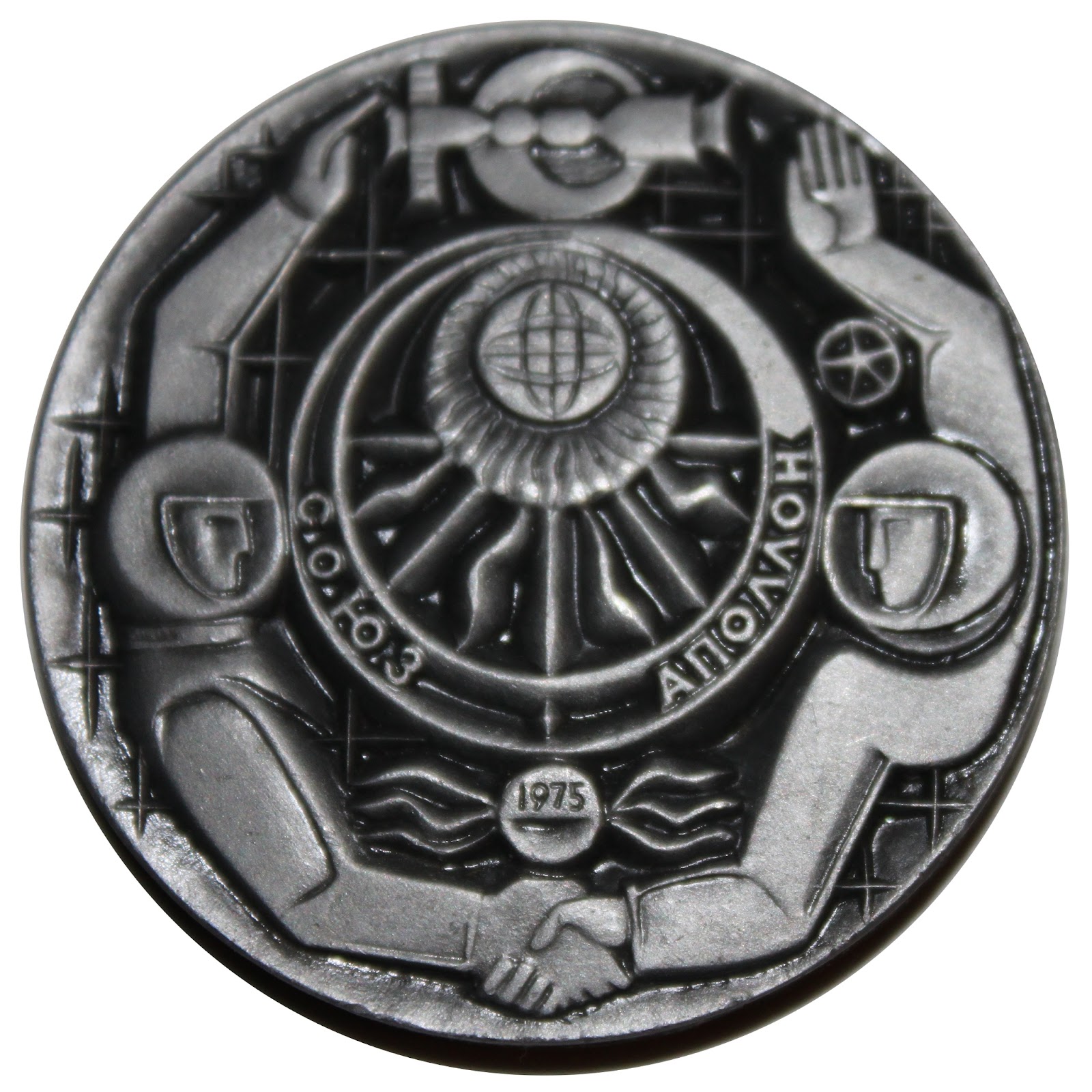
This week’s item, like last week’s, was issued to commemorate the collaborative Apollo–Soyuz mission flown by the United States and the Soviet Union in 1975. Last week’s was issued by NASA, this week’s by the Ленинградский монетный двор (ЛМД—Leningrad Mint, LMD; today, Санкт-Петербургский монетный двор, СПМД, St Petersburg Mint, SPMD) in the Soviet Union. Amongst other items, the Leningrad Mint produced commemorative coins for the Soviet Union and medals for the Soviet military forces. Unlike the NASA medallion from last time, this item was not produced specifically for workers in the space program, but as a commercially available souvenir.


The medallion measures 40 mm (1⅝”) in diameter and is made from some lightweight alloy—mostly aluminium I guess—with a very dull lustre. Like its American counterpart from last week, it contains metal that actually flew in space.

The obverse of the medallion features a symbolic representation of the mission: two space-suited figures shaking hands, with a depiction of the docked Soyuz and Apollo spacecraft at the top (the Russian text on the medallion simply reads “Soyuz” and “Apollo”).

The design is titled “Рукопожатие в космосе”—“Handshake in Space” and was created by cosmonaut Aleksei Arkhipovich Leonov. Leonov is a renowned space artist and also commanded the Soyuz 19 spacecraft that participated in this mission.1 The style is one that I immediately associate with eastern European poster art, but for which I do not know the correct term.2

The reverse of the medallion is blank, and clearly shows the grainy composition of the metal.

This particular medallion is part of a set of six that was issued to commemorate the mission. The obverse sides of the other five medallions feature relief portraits of the three American astronauts and two Soviet cosmonauts who participated in the flight, and the reverse sides feature their autographs.

Special thanks to Alex Panchenko for his expert advice on the history and background to this medallion. Visit his website on Soviet and Russian aerospace collectibles at www.ussr-airspace.com

Footnotes:
1Leonov was also the first person to step outside a spacecraft and “walk” in space (on the Voskhod 2 mission in March 1965) and was selected to command the first Soviet crew to the moon (the mission was cancelled). After the Apollo–Soyuz mission, he became head of the cosmonaut corps and then deputy director of cosmonaut training. The fictional spacecraft that took the joint Soviet–American crew to Jupiter in Arthur C. Clarke’s novel 2010: Odyssey Two was named after him, as is a crater on the moon, and an asteroid.
2To my unqualified eye, I would say there are cubist and futurist elements here; but both those movements were long dead by the 1950s and 1960s and the poster art which which I’m familiar. I’d love to know if there’s a better way to describe this style; I like it very much.


Copyright information: Leonov is still alive, and copyright in this work likely belongs to him. The St Petersburg Mint might also hold rights to the exploitation of the work. The artwork is imaged here for informational and educational purposes only, per article 19.1 and 19.2 of Об авторском праве и смежных правахOn Copyright and Neighbouring Rights, law of the Russian Federation (1993, amended 1995 and 2004). 

Tuesday, June 5, 2012

Apollo-Soyuz Test Project medallion from NASA MFA Office

The collecting of memorabilia of any kind—whether it be movie memorabilia, sporting memorabilia, or spaceflight memorabilia—is essentially an exercise in fetishism: the relics in our collections provide us with tangible links to intangible moments and events in space and time. It is therefore not surprising that in the hierarchy of desirability of space relics, items that have actually flown in space are more highly sought-after than those that have not.1 These “flown” items take us places where most of us can’t go and times when none of us can.

A few weeks ago, I blogged here about an example of a certificate that NASA’s Manned Flight Awareness Office (MFA—later renamed Spaceflight Awareness Office, SFA) awarded to employees and contractors. This week’s artifact is from the Apollo–Soyuz Test Project, a goodwill mission carried out jointly by the United States and Soviet Union in July 1975. It too is an award, but goes one better. As well as the certificate itself, the employee or contractor received a medallion made, in part, from metal that had flown on the mission:


The medallion is 38 mm (1½”) across and made of very light metal; mostly aluminium I think. According to the text on the reverse, it contains metal from both the American Apollo and the Soviet Soyuz spacecraft that participated in the mission. I find that idea quite appealing: some small part of these historic craft now forever intermingled and inseparable. In the photos, the roughness of its manufacture is obvious, and this is an example that was still in its original packaging when it came into my collection!

The practise of issuing such medallions began with Apollo 8 in 1969, to commemorate the first time human beings had flown to the moon and back. Many early examples (including this one) were manufactured for NASA by the now-defunct Barco Mint of New Orleans. Altogether, the MFA and SFA have issued 15 such medallions, the most recent being for Space Shuttle flight STS-114 in 2005, to commemorate the program’s safe return to operations after the Columbia accident.

Like many of the MFA medallions, this one was issued with a certificate that included a place where the medallion could be glued. My example was originally presented to an employee of the Rockwell International corporation (today part of Boeing)—Rockwell built the docking module that allowed the dissimilar spacecraft to link up. I’ve obscured the employee’s name here for their privacy.

The certificate includes text in both English and Russian, and bears facsimiles of the signatures of the three American astronauts and two Soviet cosmonauts who flew on the mission. It also bears the two different mission insignia developed for the mission (top and bottom right), and also an unofficial, cartoon insignia (lower left).


This emblem features caricatures of the two spacecraft docked, the Soyuz being ridden by a cartoon bear, the Apollo being ridden by Snoopy, of Peanuts fame. Snoopy says “Right on!” and the Russian bear says “Поехали!” (“Poyekhali” — “Let’s go!”)2 Snoopy became an official mascot of the US space program in 1968, specifically in connection with flight safety, and the bear has long been a symbol of Russia.

Footnotes:
1Items that have flown to the moon are generally more highly prized than items that have only flown in Earth orbit; and items used on the surface of the moon are most highly prized of all.
 2Yuri Gagarin exclaimed “Поехали!” as he was launched on Vostok 1 on 12 April 1961 at the start of his flight to become the first person in space.


Copyright information: The medal, certificate design, and official emblems are all works by NASA, and as works of the US federal government are in the public domain. However, copyright to Snoopy’s likeness that appears on the cartoon emblem belonged originally to United Feature Syndicate and today to Peanuts Worldwide LLC. Reproduction here is for educational purposes only.

Saturday, May 26, 2012

Apollo-Soyuz Test Project press kit items from NASA JSC

In July 1975, an American Apollo spacecraft docked with a Soviet Soyuz spacecraft for two days of joint scientific experiments. Before and after the docking, the two spacecraft manœuvered around each other and made additional dockings and undockings to give their crews and ground controllers experience with joint operation of these two very different craft. The Apollo–Soyuz Test Project (ASTP; in Russian, Экспериментальный полёт «Аполлон» — «Союз», or ЭПАС) stands out as a triumph of international scientific co-operation and goodwill against the backdrop of the Cold War. A few items from the press kit issued by NASA’s Johnson Space Center (JSC) provide an introduction to this landmark mission:

This first item is a small slip of paper, 6 cm × 15 cm (4½” × 6”) with the background and objectives of the mission explained on both sides. It’s printed on a lightweight beige stock with a linen face. I particularly like the 1970s typography in the title.

It begins:
“Three years of combined effort by the world’s leading space powers will culminate with dual launches for the first international manned space flight, the result of a May 1972 US–USSR agreement to design and test a compatible docking system for future spacecraft and space stations.

A milestone in international space cooperation, the Apollo Soyuz Test Project calls for the docking of a US Apollo and a USSR Soyuz in Earth orbit to test jointly designed rendezvous and docking equipment and procedures. The test lays the groundwork for future activities involving manned spacecraft of the two nations, and may help to make space rescues possible in years to come.”

It would take twenty years, but the hopes expressed in these paragraphs would prove fruitful. The Androgynous Peripheral Attach System (APAS) docking mechanism designed for this mission would provide the basis for the American Space Shuttle to dock with the Russian Mir space station and later with the International Space Station.1

The second item is a card, 18 cm × 13 cm (7” × 5”) that contains the schedule for the mission, as at 23 May 1975. It includes four alternate date ranges for successive days in July in case the launch did not occur as planned on 15 July (as it happened, the mission ran to schedule).


The third item is a card, 26.5 cm × 20 cm (10½” × 8”) that presents the mission profile in graphical form, beginning with the launch of the Soyuz spacecraft from Kazakhstan, and finishing with the splashdown of the Apollo spacecraft in the Pacific Ocean. The text throughout is in both English and Russian.


The back of the card presents an information summary of all2 American human spaceflights up to that time, covering the Mercury, Gemini, Apollo, and Skylab programs: thirty missions with a total cumulative time in space of 21,851 person hours!


Footnotes:
1The docking mechanism of the Chinese Shenzhou spacecraft is designed to be compatible with APAS too, making dockings of Shenzhou and the International Space Station technically feasible.
2The summary is not quite complete. It includes the two sub-orbital flights carried out as part of the Mercury Program (Mercury-Redstone 3 and Mercury-Redstone 4) but excludes thirteen sub-orbital flights of the X-15 rocket plane that, between 1962 and 1968, met the American definition for a spaceflight that was then in use. As defined in the US at the time, a spaceflight was any flight that reached an altitude of 50 miles (80 km). Furthermore, two of these flights—flight 90 and 91, both made by Joe Walker—also met the international definition for a spaceflight (a flight reaching an altitude of 100 km—62 miles). If the Mercury-Redstone flights were spaceflights, the X-15 flights were too. The incredible X-15 is sadly a too-often overlooked chapter of spaceflight history.


Copyright information: These three items come from a NASA press kit. The schedule and the profile are clearly NASA publications and, as works of the US federal government, are in the public domain. The mission schedule card is US Government Printing Office publication 1975—671-549/13 and the mission profile card carries the NASA image number S-74-3297. The small overview sheet does not provide any publication details, so at the very least, as a publication in the United States before 1989 without a copyright notice, it would be in the public domain anyway, even if it were not a federal government publication.


Saturday, May 19, 2012

Skylab reboost concept art

After the Skylab 4 crew returned to Earth in February 1974, NASA had no further plans for the space station and shut down its systems. Prior to undocking, the crew had used the engine of their Apollo spacecraft to nudge Skylab into a higher orbit, roughly 440 km above the Earth. However, even at this height, the Earth’s atmosphere is dense enough to exert significant drag on a satellite. A period of increased solar activity in the 1970s made this situation worse for Skylab. This activity caused the density of the atmosphere at Skylab’s altitude to increase, and therefore the drag on the station to increase in proportion.

Based on measurements taken during the Skylab missions, NASA predicted that the station would remain in orbit another nine years, re-entering Earth’s atmosphere sometime in 1983.

Doomed if left where it was, the station still represented a valuable collection of resources in orbit: air, water, and shelter that NASA had already  paid to carry up there. By 1977, with the Space Shuttle program well underway, NASA planners recognised an opportunity to save the station for refurbishment and reuse. With orbital flights of the shuttle scheduled to begin in mid 1979, NASA contracted Martin Marietta Corporation (today, absorbed into Lockheed Martin) to develop a booster that could be carried to Skylab by a space shuttle and used to raise Skylab’s orbit out of imminent danger, as illustrated in this piece of concept art:


Here’s a close-up of the booster module itself, designated the Teleoperator Retrieval System (TRS):


It’s docked to the main port of Skylab’s Multiple Docking Adapter (MDA). The square plate visible at the centre of the cluster of engines carries an attachment point to allow the shuttle’s robot arm (Remote Manipulator System — RMS) to grasp the module and manœuver it into position. Note also that Skylab’s main solar array has been re-folded into its launch position (it’s the long, flat, rectangular structure along the side of the station with the words “United States” barely legible along it). I presume this was to keep the station’s centre of mass as close as possible to the TRS’s line of thrust during the boost, as well as to minimise stresses on the array—although the solar panels on the Apollo Telescope Mount (ATM) are still fully deployed.

Safe in its new orbit, Skylab would then be ready for renovations and expansions to keep it in useful service perhaps as far as 1989. Alternatively, NASA also considered the possibility of using the TRS to de-orbit Skylab in a safe, controlled manner, far away from human populations (Skylab’s orbit carried it over around 90% of the world’s people).

However, none of this was to be. Solar activity through the 1970s remained higher than predicted, and by April 1979, it was clear that Skylab would not last longer than a few more months. It was also clear that the Space Shuttle was nowhere near ready: ongoing problems and delays with its revolutionary new heat shield and engines postponed the first orbital flight past the end of the year.

On 11 July 1979, Skylab’s orbit decayed and brought the station down in an uncontrolled1 re-entry over the Indian Ocean and Western Australia.

On 12 April 1981, the first space shuttle flew.

Incidentally, I’d love to know the name of the artist who did the original painting. If you know, please leave me a note!

Footnote:
1 Well, almost uncontrolled. As the station crossed the east coast of North America, headed  south-east on what was almost certainly to be its final orbit, ground controllers fired the station’s thrusters to set it tumbling in its orbit. This tumble was intended to maximise the atmospheric drag and bring Skylab down as quickly as possible, hopefully somewhere in the South Atlantic or Indian Ocean and before it re-appeared over the Pacific North-West of the United States.


Copyright information: The print in my collection was formerly held by a newspaper archive. It is a black-and-white version of NASA image S78-23631. As a work of the US federal government, this image is in the public domain.

Saturday, May 12, 2012

Skylab 4 certificate from NASA MFA Office

I work for a large organisation that regularly hands out awards of various kinds to recognise excellence or to celebrate particular milestones. I therefore feel some kind of camaraderie with the recipient of this award, although I never knew them personally.

These certificates were printed for employees of NASA and its contractors to commemorate the success of Skylab 4 — the third and final mission to take a crew to the space station.


Printed on US letter-size paper, it displays the insignia of the Skylab program, plus mission insignias for all three Skylab crews (with Skylab 4’s the largest). The employee’s name is printed below (blurred out here for their privacy), together with a short message of appreciation, and facsimiles of the signatures of the three astronauts who flew the mission: Jerry Carr, Ed Gibson, and Bill Pogue.

This is an ordinary piece of paper made extraordinary by its association with an extraordinary achievement. Skylab 4 put a crew of three astronauts on a space station for 84 days of scientific research and returned them safely to Earth.

I sometimes wonder whether any of the ephemera from our office will one day be collectable to someone!


Copyright information: this certificate was issued by NASA’s Manned Spaceflight Awareness Office. As a work of the US federal government, it is in the public domain.

Saturday, May 5, 2012

Skylab 3 press kit from the US DoD

This week’s artifact is a press kit issued by the United States Department of Defense to describe the contribution of the military to the Skylab 3 mission. Probably the most visible role was that of the recovery forces: prior to the Space Shuttle, American spacecraft landed (“splashed down”) in the ocean. The astronauts and their capsule were recovered by helicopter and brought aboard an aircraft carrier waiting nearby.

However, as the press kit points out, the military involvement went far beyond recovering the spacecraft. Throughout Skylab 3’s launch and return, 2,260 members of the United States Air Force and United States Navy provided tracking, communications, safety, rescue, and meteorological services. Three ships and 51 aircraft were assigned to these efforts: a sizeable undertaking.

To most people, perhaps the most interesting thing about the document is how incredibly crude its production appears by today’s standards. The document itself is sixty pages of heavy stock in the old government letter size of 8” × 10½” (203 mm × 267 mm). Black-and-white printing appears on one side of the page only.

In 2012, any crank who hands out flyers on a street corner has slicker-looking material than the US Department of Defense was producing only forty years ago. Conversely, I’m struck by how closely some vintage sci-fi fanzines from the same era in my collection resemble this press kit: those amateurs were doing some impressive work.

One day, I’d like to scan the entire document for posterity, but the stapled binding on my copy is very tight, and getting good scans without damaging it will be a time-consuming challenge. For now, here are a few representative pages that deal with the recovery effort by USS New Orleans off the coast of California. New Orleans was flagship of Task Force 130, based at Pearl Harbor under Rear Admiral John L. Butts, Jr.


Copyright information: The text and images in this press kit are the work of the United States federal government, and therefore in the public domain.