Showing posts with label 1975. Show all posts

Tuesday, June 12, 2012

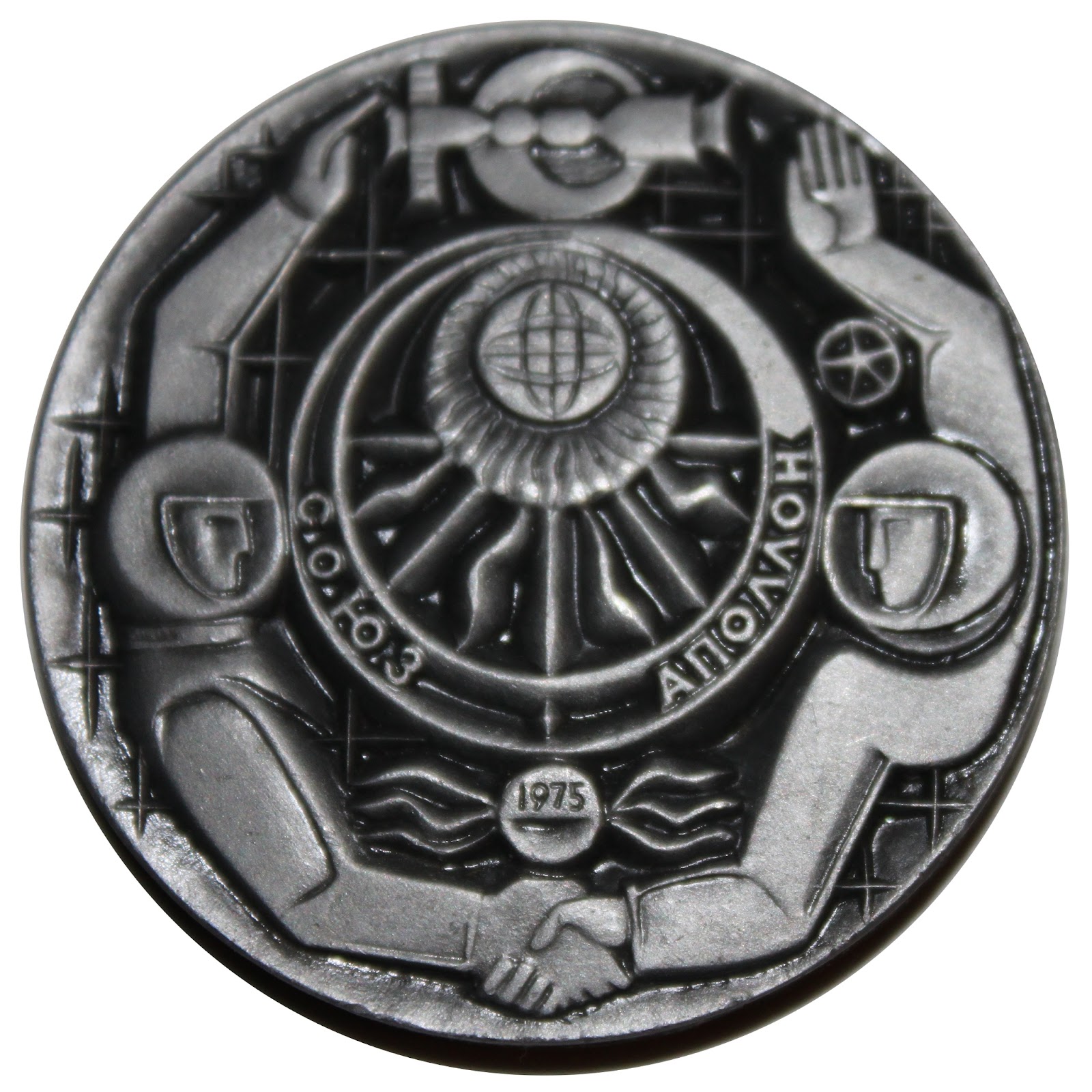
Apollo-Soyuz Test Project medallion from the Soviet Union

This week’s item, like last week’s, was issued to commemorate the collaborative Apollo–Soyuz mission flown by the United States and the Soviet Union in 1975. Last week’s was issued by NASA, this week’s by the Ленинградский монетный двор (ЛМД—Leningrad Mint, LMD; today, Санкт-Петербургский монетный двор, СПМД, St Petersburg Mint, SPMD) in the Soviet Union. Amongst other items, the Leningrad Mint produced commemorative coins for the Soviet Union and medals for the Soviet military forces. Unlike the NASA medallion from last time, this item was not produced specifically for workers in the space program, but as a commercially available souvenir.


The medallion measures 40 mm (1⅝”) in diameter and is made from some lightweight alloy—mostly aluminium I guess—with a very dull lustre. Like its American counterpart from last week, it contains metal that actually flew in space.

The obverse of the medallion features a symbolic representation of the mission: two space-suited figures shaking hands, with a depiction of the docked Soyuz and Apollo spacecraft at the top (the Russian text on the medallion simply reads “Soyuz” and “Apollo”).

The design is titled “Рукопожатие в космосе”—“Handshake in Space” and was created by cosmonaut Aleksei Arkhipovich Leonov. Leonov is a renowned space artist and also commanded the Soyuz 19 spacecraft that participated in this mission.1 The style is one that I immediately associate with eastern European poster art, but for which I do not know the correct term.2

The reverse of the medallion is blank, and clearly shows the grainy composition of the metal.

This particular medallion is part of a set of six that was issued to commemorate the mission. The obverse sides of the other five medallions feature relief portraits of the three American astronauts and two Soviet cosmonauts who participated in the flight, and the reverse sides feature their autographs.

Special thanks to Alex Panchenko for his expert advice on the history and background to this medallion. Visit his website on Soviet and Russian aerospace collectibles at www.ussr-airspace.com

Footnotes:
1Leonov was also the first person to step outside a spacecraft and “walk” in space (on the Voskhod 2 mission in March 1965) and was selected to command the first Soviet crew to the moon (the mission was cancelled). After the Apollo–Soyuz mission, he became head of the cosmonaut corps and then deputy director of cosmonaut training. The fictional spacecraft that took the joint Soviet–American crew to Jupiter in Arthur C. Clarke’s novel 2010: Odyssey Two was named after him, as is a crater on the moon, and an asteroid.
2To my unqualified eye, I would say there are cubist and futurist elements here; but both those movements were long dead by the 1950s and 1960s and the poster art which which I’m familiar. I’d love to know if there’s a better way to describe this style; I like it very much.


Copyright information: Leonov is still alive, and copyright in this work likely belongs to him. The St Petersburg Mint might also hold rights to the exploitation of the work. The artwork is imaged here for informational and educational purposes only, per article 19.1 and 19.2 of Об авторском праве и смежных правахOn Copyright and Neighbouring Rights, law of the Russian Federation (1993, amended 1995 and 2004). 

Tuesday, June 5, 2012

Apollo-Soyuz Test Project medallion from NASA MFA Office

The collecting of memorabilia of any kind—whether it be movie memorabilia, sporting memorabilia, or spaceflight memorabilia—is essentially an exercise in fetishism: the relics in our collections provide us with tangible links to intangible moments and events in space and time. It is therefore not surprising that in the hierarchy of desirability of space relics, items that have actually flown in space are more highly sought-after than those that have not.1 These “flown” items take us places where most of us can’t go and times when none of us can.

A few weeks ago, I blogged here about an example of a certificate that NASA’s Manned Flight Awareness Office (MFA—later renamed Spaceflight Awareness Office, SFA) awarded to employees and contractors. This week’s artifact is from the Apollo–Soyuz Test Project, a goodwill mission carried out jointly by the United States and Soviet Union in July 1975. It too is an award, but goes one better. As well as the certificate itself, the employee or contractor received a medallion made, in part, from metal that had flown on the mission:


The medallion is 38 mm (1½”) across and made of very light metal; mostly aluminium I think. According to the text on the reverse, it contains metal from both the American Apollo and the Soviet Soyuz spacecraft that participated in the mission. I find that idea quite appealing: some small part of these historic craft now forever intermingled and inseparable. In the photos, the roughness of its manufacture is obvious, and this is an example that was still in its original packaging when it came into my collection!

The practise of issuing such medallions began with Apollo 8 in 1969, to commemorate the first time human beings had flown to the moon and back. Many early examples (including this one) were manufactured for NASA by the now-defunct Barco Mint of New Orleans. Altogether, the MFA and SFA have issued 15 such medallions, the most recent being for Space Shuttle flight STS-114 in 2005, to commemorate the program’s safe return to operations after the Columbia accident.

Like many of the MFA medallions, this one was issued with a certificate that included a place where the medallion could be glued. My example was originally presented to an employee of the Rockwell International corporation (today part of Boeing)—Rockwell built the docking module that allowed the dissimilar spacecraft to link up. I’ve obscured the employee’s name here for their privacy.

The certificate includes text in both English and Russian, and bears facsimiles of the signatures of the three American astronauts and two Soviet cosmonauts who flew on the mission. It also bears the two different mission insignia developed for the mission (top and bottom right), and also an unofficial, cartoon insignia (lower left).


This emblem features caricatures of the two spacecraft docked, the Soyuz being ridden by a cartoon bear, the Apollo being ridden by Snoopy, of Peanuts fame. Snoopy says “Right on!” and the Russian bear says “Поехали!” (“Poyekhali” — “Let’s go!”)2 Snoopy became an official mascot of the US space program in 1968, specifically in connection with flight safety, and the bear has long been a symbol of Russia.

Footnotes:
1Items that have flown to the moon are generally more highly prized than items that have only flown in Earth orbit; and items used on the surface of the moon are most highly prized of all.
 2Yuri Gagarin exclaimed “Поехали!” as he was launched on Vostok 1 on 12 April 1961 at the start of his flight to become the first person in space.


Copyright information: The medal, certificate design, and official emblems are all works by NASA, and as works of the US federal government are in the public domain. However, copyright to Snoopy’s likeness that appears on the cartoon emblem belonged originally to United Feature Syndicate and today to Peanuts Worldwide LLC. Reproduction here is for educational purposes only.

Saturday, May 26, 2012

Apollo-Soyuz Test Project press kit items from NASA JSC

In July 1975, an American Apollo spacecraft docked with a Soviet Soyuz spacecraft for two days of joint scientific experiments. Before and after the docking, the two spacecraft manœuvered around each other and made additional dockings and undockings to give their crews and ground controllers experience with joint operation of these two very different craft. The Apollo–Soyuz Test Project (ASTP; in Russian, Экспериментальный полёт «Аполлон» — «Союз», or ЭПАС) stands out as a triumph of international scientific co-operation and goodwill against the backdrop of the Cold War. A few items from the press kit issued by NASA’s Johnson Space Center (JSC) provide an introduction to this landmark mission:

This first item is a small slip of paper, 6 cm × 15 cm (4½” × 6”) with the background and objectives of the mission explained on both sides. It’s printed on a lightweight beige stock with a linen face. I particularly like the 1970s typography in the title.

It begins:
“Three years of combined effort by the world’s leading space powers will culminate with dual launches for the first international manned space flight, the result of a May 1972 US–USSR agreement to design and test a compatible docking system for future spacecraft and space stations.

A milestone in international space cooperation, the Apollo Soyuz Test Project calls for the docking of a US Apollo and a USSR Soyuz in Earth orbit to test jointly designed rendezvous and docking equipment and procedures. The test lays the groundwork for future activities involving manned spacecraft of the two nations, and may help to make space rescues possible in years to come.”

It would take twenty years, but the hopes expressed in these paragraphs would prove fruitful. The Androgynous Peripheral Attach System (APAS) docking mechanism designed for this mission would provide the basis for the American Space Shuttle to dock with the Russian Mir space station and later with the International Space Station.1

The second item is a card, 18 cm × 13 cm (7” × 5”) that contains the schedule for the mission, as at 23 May 1975. It includes four alternate date ranges for successive days in July in case the launch did not occur as planned on 15 July (as it happened, the mission ran to schedule).


The third item is a card, 26.5 cm × 20 cm (10½” × 8”) that presents the mission profile in graphical form, beginning with the launch of the Soyuz spacecraft from Kazakhstan, and finishing with the splashdown of the Apollo spacecraft in the Pacific Ocean. The text throughout is in both English and Russian.


The back of the card presents an information summary of all2 American human spaceflights up to that time, covering the Mercury, Gemini, Apollo, and Skylab programs: thirty missions with a total cumulative time in space of 21,851 person hours!


Footnotes:
1The docking mechanism of the Chinese Shenzhou spacecraft is designed to be compatible with APAS too, making dockings of Shenzhou and the International Space Station technically feasible.
2The summary is not quite complete. It includes the two sub-orbital flights carried out as part of the Mercury Program (Mercury-Redstone 3 and Mercury-Redstone 4) but excludes thirteen sub-orbital flights of the X-15 rocket plane that, between 1962 and 1968, met the American definition for a spaceflight that was then in use. As defined in the US at the time, a spaceflight was any flight that reached an altitude of 50 miles (80 km). Furthermore, two of these flights—flight 90 and 91, both made by Joe Walker—also met the international definition for a spaceflight (a flight reaching an altitude of 100 km—62 miles). If the Mercury-Redstone flights were spaceflights, the X-15 flights were too. The incredible X-15 is sadly a too-often overlooked chapter of spaceflight history.


Copyright information: These three items come from a NASA press kit. The schedule and the profile are clearly NASA publications and, as works of the US federal government, are in the public domain. The mission schedule card is US Government Printing Office publication 1975—671-549/13 and the mission profile card carries the NASA image number S-74-3297. The small overview sheet does not provide any publication details, so at the very least, as a publication in the United States before 1989 without a copyright notice, it would be in the public domain anyway, even if it were not a federal government publication.